
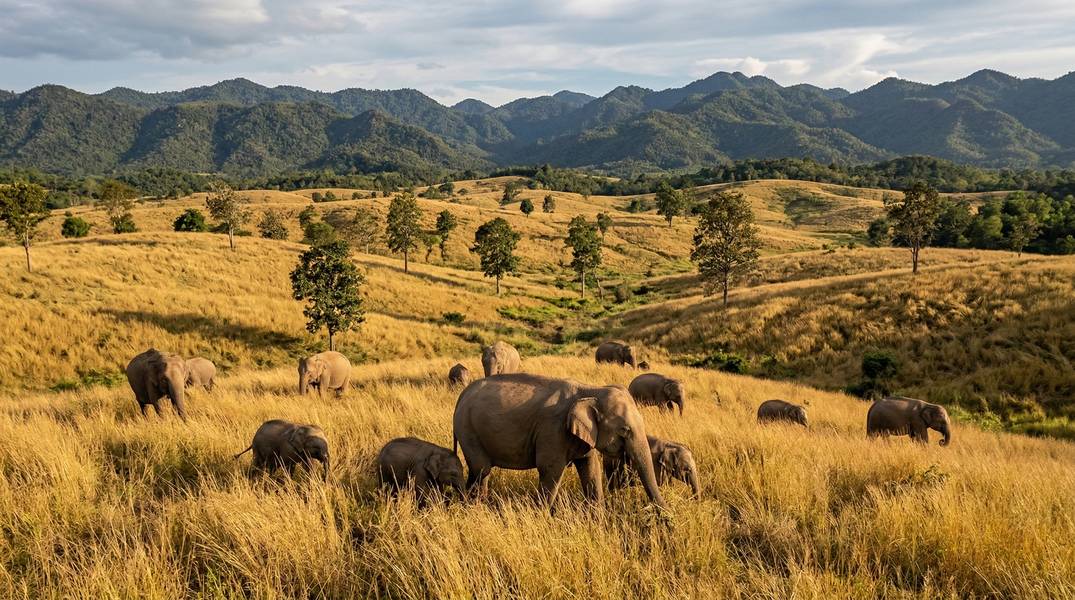
Kui Buri National Park
Overview
อุทยานแห่งชาติกุยบุรี • Kui Buri National Park
Established in 1999 as Thailand’s 90th national park, Kui Buri covers 969 sq km of mountainous terrain along the Tenasserim Hills on the Myanmar border. The park became part of the Kaeng Krachan Forest Complex UNESCO World Heritage Site in July 2021, recognized for its extraordinary biodiversity alongside Kaeng Krachan National Park, Chaloem Phrakiat Thai Prachan National Park, and Mae Nam Phachi Wildlife Sanctuary.
Kui Buri’s reputation rests on a single, remarkable achievement: it is Thailand’s best place to see wild Asian elephants in their natural habitat, ethically and reliably. Safari vehicles report a 95-97% success rate for elephant sightings, making it one of the most dependable wildlife viewing experiences in Southeast Asia. The park is equally significant as a conservation success story — the internationally recognized “Kui Buri Model” transformed human-elephant conflict communities into conservation stewards, with zero elephants poached since 2010.
For medical tourists, Kui Buri offers an unusually accessible nature experience. The entire wildlife safari is conducted from a seated position in a vehicle, requires no walking, and operates in the afternoon — leaving mornings free for rest or medical appointments. The park is an easy day trip from Hua Hin, a major medical tourism hub with JCI-accredited hospitals.
Important: Park fees, hours, trail conditions, and wildlife behavior are subject to change without notice. Verify current information at the official DNP website before your visit. Wildlife sightings, while highly likely, cannot be guaranteed. Weather conditions may affect safari operations.
Why Kui Buri is Special
The Kui Buri Model
Kui Buri is internationally recognized as a model for resolving human-wildlife conflict. In the late 1990s, crop-raiding elephants and retaliatory killings threatened both the elephant population and surrounding farming communities. A royal intervention by King Bhumibol Adulyadej after two elephants were killed in 1997 — one poisoned, one shot and burned — catalyzed change.
WWF-Thailand partnered with the DNP and local communities to develop a co-management approach that converted former poaching communities into conservation guardians:
- Safari guides and drivers: Former conflict-affected community members now earn income from tourism
- SMART Early Warning System: A joint initiative between True Corporation, DNP, and WWF (since 2017) using camera traps at 25 “Elephant Checkpoint” locations — reducing crop damage from elephants from 25% to 4% by 2019
- Bee fence barriers: Beehive fences deter elephants from croplands without harm
- Habitat restoration: Former pineapple plantation land returned to the state for grassland restoration — this regenerating habitat is now the prime elephant viewing area
Results: Human-elephant conflict incidents dropped from 332 (2005) to 146 (2014). WWF-International ranked Kui Buri as Best Practice in Asia for Human-Elephant Conflict Mitigation in November 2015.
UNESCO World Heritage Connection
Kui Buri is part of the Kaeng Krachan Forest Complex, inscribed as a UNESCO World Heritage Site on July 26, 2021. The complex covers four protected areas totaling 409,000 hectares along the Tenasserim Mountain Range.
Highest Elephant Sighting Success Rate
With a documented 95-97% success rate for elephant encounters, Herds of wild Asian elephants — estimated at 230-320 individuals — regularly emerge onto regenerating grasslands each afternoon to graze, though sightings can never be guaranteed. Gaur (Indian bison) sightings are also common at around 88%.
Wildlife & Nature
What You Might See
Wildlife sightings depend on season, time of day, and luck. Animals roam freely across 969 sq km of protected wilderness.
| Animal | Best Time | Best Location | Likelihood |
|---|---|---|---|
| Asian elephant (~300 individuals) | 3:30-5:30 PM | Huai Luek grasslands | Very good (95-97%) |
| Gaur / Indian bison (~100+ individuals) | Late afternoon | Huai Luek grasslands | Good (88%) |
| Golden jackal | Late afternoon, dusk | Grassland edges | Moderate |
| Sambar deer | Late afternoon | Grassland and forest edge | Good |
| Red muntjac (barking deer) | Late afternoon | Forest edge | Good |
| Wild boar | Late afternoon | Grasslands | Good |
| Lesser mouse deer | Dusk | Forest floor | Moderate |
| Malayan tapir | Night | Forest interior | Rare |
| Banteng (wild cattle) | Late afternoon | Grasslands | Rare |
| Leopard | Night | Forest interior | Rare |
| Clouded leopard | Night | Forest canopy | Very rare |
| Dhole (Asiatic wild dog) | Daytime | Throughout park | Rare |
| Tiger | Any time | Throughout park | Extremely rare (camera trap confirmed) |
| Pangolin | Night | Throughout park | Extremely rare (camera trap confirmed) |
Warning: Wild elephants are dangerous. Maintain safe distance at all times, stay in the safari vehicle, do not make loud noises or sudden movements, and follow all guide instructions. Never feed, approach, or provoke any wildlife.
Birdwatching
Kui Buri has 260-320 recorded bird species, with excellent opportunities for hornbill and peafowl observation.
Notable Species:
- Great hornbill
- Plain-pouched hornbill (rare)
- Oriental pied hornbill
- Tickell’s brown hornbill
- Green peafowl
- Red junglefowl
- Great slaty woodpecker (rare)
- Red-bearded bee-eater
- Indochinese roller
- Black-and-red broadbill
- Blue-winged pitta (seasonal migrant)
- Asian openbill stork
- White-rumped shama
Best Times: Early morning near headquarters area; late afternoon during the wildlife safari.
Flora & Ecology
The park spans elevations from 100m to 1,200m with a mosaic of forest types:
- Dry evergreen forest (~40% of the park)
- Deciduous forest (~30%)
- Tropical rainforest (~30%)
Notable Flora:
- Sandalwood: Over 200,000 trees — the only place in Thailand where sandalwood is harvested for royal cremations
- Dipterocarpus tuberculatus, Hopea odorata, Terminalia chebula
- Various palm, teak, bamboo, and Shorea species
Activities & Experiences
Wildlife Safari (Primary Activity)
The guided safari is Kui Buri’s signature experience — and one of the easiest wildlife activities in Thailand.
| Detail | Information |
|---|---|
| Format | Open-back pickup truck with local guide/driver |
| Duration | 2-3 hours |
| Area | Huai Luek Wildlife Watching Area — grassland and regenerating forest |
| Hours | 14:00-18:00 daily |
| Recommended arrival | 14:00-15:00 (last entry 17:00) |
| Difficulty | Easy — entirely seated, no walking |
| Success rate | 95-97% for elephants |
| Best viewing | 15:30-17:30 (elephants emerge to graze in late afternoon golden hour) |
| Cost | 850 THB per group (max 6 foreigners) |
| Daily limit | 100 safari vehicles |
Safari Rules:
- Must use park safari vehicles — no private vehicles
- No walking in wildlife area — observation from vehicle only
- No loud noises or sudden movements
- No feeding or baiting wildlife
- No getting out of vehicle unless instructed by guide
- No flash photography
- Keep receipt for inspection
Hiking Trails
| Trail | Distance | Difficulty | Time | Post-Surgery Suitability |
|---|---|---|---|---|
| Headquarters nature trails | Various short trails | Easy-Moderate | 1-2 hours | Week 3+ (dental, minor cosmetic) |
| Khao Luang Trail | Moderate distance | Moderate | Half day | Not recommended during recovery |
Hiking trails are located near Park Headquarters, separate from the wildlife watching area. Own vehicle needed to reach trailheads. Some trails may be inaccessible during heavy rains.
Note: No walking trails exist in the main wildlife watching area — it is 100% vehicle-based observation.
Huay Dong Mai Fai Waterfall
A 15-level waterfall and the park’s largest water feature. Some levels have pools suitable for swimming.
- Difficulty: Moderate (uneven terrain between levels)
- Best season: Rainy season (June-November) for peak flow
- Post-surgery suitability: Not recommended during early recovery
Photography
| Spot | Subject | Best Time | Notes |
|---|---|---|---|
| Huai Luek grassland viewpoints | Elephants, gaur, golden hour | 16:00-17:30 | Dusty — protect camera equipment |
| Waterfall areas near HQ | Cascades, forest | Morning | Best during rainy season |
| Safari viewpoints | Wildlife panorama | Late afternoon | Telephoto lens recommended (200mm+) |
Photography Tips: Very dusty conditions on safari trucks in dry season — bring a dust cover or ziplock bags for camera bodies. Late afternoon golden hour (4:00-5:30 PM) coincides perfectly with peak elephant activity. Bring telephoto lens — elephants are often viewable from 50-100m but closer shots require reach.
Other Activities
- Birdwatching: 260-320 species; excellent from vehicle during safari or gentle walks near HQ
- Camping: Basic facilities at park; tent rental available
- Visiting Yang Chum Reservoir: Peaceful royal initiative water project nearby
- Visiting Phra Pratun Cave: Ancient Buddha statues with natural light effects, near Kui Buri
For Medical Tourists
Physical Requirements Assessment
| Factor | Level | Details |
|---|---|---|
| Walking Distance | Minimal | Wildlife viewing entirely from safari vehicle. Short walk to/from vehicle at visitor center. |
| Elevation | Low | Wildlife watching area at low elevation (~100-200m) |
| Temperature | Moderate-High | Afternoon activity (14:00-18:00); hottest April-May |
| Shade | Limited | Open-air safari truck — sun exposure for 2-3 hours |
| Rest Areas | Fair | Visitor center with seating, toilets, and food |
| Mobile Signal | Limited | Some coverage at HQ; weak to none in wildlife area |
Recovery Week Recommendations
| Activity | Difficulty | Earliest Safe | Ideal Week | Key Considerations |
|---|---|---|---|---|
| Wildlife safari (vehicle-based) | Easy | Week 1 | Week 1+ | Seated activity; heat and dust are main concerns |
| Birdwatching from vehicle | Easy | Week 1 | Week 1+ | No walking required |
| Visitor center and grounds | Easy | Week 1 | Week 1+ | Short walks, seating available |
| HQ nature trails (short) | Easy-Moderate | Week 3 | Week 3+ | Unpaved; shade available |
| Huay Dong Mai Fai Waterfall | Moderate | Week 4 | Week 5+ | Uneven terrain between levels |
| HQ nature trails (longer) | Moderate | Week 4 | Week 4+ | Doctor approval recommended |
Procedure-Specific Guidance
| Procedure Type | Earliest Visit | Recommended Activities |
|---|---|---|
| Dental (simple) | Week 1 | Safari, visitor center |
| Dental implant | Week 1 | Safari (dust protection for healing mouth) |
| LASIK | Week 1 | Safari; bring UV-protective sunglasses, dust protection |
| Minor cosmetic | Week 1 | Safari; bring sun protection for healing skin |
| Rhinoplasty | Week 2 | Safari only; avoid dusty conditions if possible |
| Abdominal surgery | Week 2 | Safari with caution — bumpy ride on dirt tracks may cause discomfort |
| Orthopedic (minor) | Week 2 | Safari; stepping into truck may require assistance |
| Cardiac procedures | Week 3+ | Consult cardiologist; heat exposure is the main concern |
| Hip/knee replacement | Week 4+ | Doctor approval required; stepping into safari truck may be difficult |
Medical Advisory: Consult your treating physician before any outdoor activities post-surgery. Kui Buri is a remote park — the nearest community hospital (Kui Buri Hospital) is approximately 30 minutes from Park HQ, and the nearest private hospitals with international-standard care are in Hua Hin (1.5 hours away). Carry a hospital contact card, prescribed medications, and sun protection. The afternoon timing (2-6 PM) means heat exposure — bring water, hat, and sunscreen.
Why Kui Buri is Ideal for Medical Tourists
- Lowest physical demand of any major Thai wildlife destination — entire experience from a seated position
- Afternoon-only activity (2-6 PM) — mornings free for rest, treatment, or medical appointments
- High success rate (95-97%) — minimal risk of “wasted” effort for patients with limited energy
- Close to Hua Hin — major medical tourism hub with JCI-accredited private hospitals and wellness resorts
- Ethical feel-good experience — the Kui Buri Model’s conservation success story offers a meaningful and uplifting outing
- No equipment needed — binoculars useful but not essential; elephants often viewable from 50-100m
Why Kui Buri Requires Caution
- Heat exposure: Open-air truck in afternoon sun for 2-3 hours; worst April-May
- Dust: Very dusty on unpaved safari tracks in dry season — respiratory and eye irritation
- Bumpy ride: Dirt and gravel tracks; may cause discomfort for abdominal or orthopedic patients
- Remote location: Limited medical facilities; no mobile signal in wildlife area
- No toilets in wildlife area: Use visitor center facilities before departure
Nearest Hospitals
| Hospital | Distance from HQ | Travel Time | Type | Key Services |
|---|---|---|---|---|
| Kui Buri Hospital | ~30 km | ~30 min | Community hospital | General medical, nutrition, physical therapy, dentistry |
| Prachuap Khiri Khan Hospital | ~60 km | ~1 hour | Provincial hospital (24-hour) | Full provincial hospital services |
| San Paolo Hospital Hua Hin | ~85 km | ~1.5 hours | Private hospital | Full private services, international patients |
| Bangkok Hospital Hua Hin | ~90 km | ~1.5 hours | Private, JCI-accredited | Full specialist services, international patient department |
Emergency Contacts:
- National Emergency / Ambulance: 1669
- Kui Buri Hospital: 032-681-108
- Prachuap Khiri Khan Hospital: 032-601-060
- Park rangers on-site during all safari operations
Visitor Information
Entry Fees
| Visitor Type | Fee |
|---|---|
| Foreign adult | 200 THB (~$5.70 USD) |
| Foreign child (3-14) | 100 THB |
| Thai adult (with ID) | 40 THB |
| Thai child | 20 THB |
| Vehicle | 30 THB |
Safari Costs:
- Safari pickup with guide: 850 THB per group (max 6 foreigners, max 8 Thai citizens)
Accommodation:
- Tent rental: 270 THB per night (including accessories)
- Bring-your-own tent: 30 THB per night
- Bungalow (3 bedrooms, 2 bathrooms): 1,800 THB per night
Payment: Cash preferred at the park. Online booking for accommodation via nps.dnp.go.th.
Fees are subject to change without notice. Verify current pricing at the official DNP website before your visit.
Opening Hours
| Service | Hours |
|---|---|
| Park (general) | Open year-round, no seasonal closure |
| Wildlife watching area | 14:00 - 18:00 daily |
| Last entry to wildlife area | 17:00 (recommended arrival by 15:00) |
Note: There is a daily limit of 100 safari vehicles. Arrive early in peak season to secure a spot.
Getting There
Navigation Warning
GPS “Kui Buri National Park” directs to Park Headquarters — this is NOT the wildlife watching area. The Huai Luek Wildlife Watching Area is 16 km north of HQ. Use GPS coordinates 12.138849, 99.646734 for the wildlife watching area.
From Bangkok by Car
| Detail | Information |
|---|---|
| Distance | ~280-290 km |
| Duration | ~4 hours |
| Route | Highway 4 (Phetkasem Road) south through Hua Hin, continue to Kui Buri district |
From Hua Hin
| Detail | Information |
|---|---|
| Distance | ~85 km |
| Duration | 1-1.5 hours by car |
| Taxi cost | 2,000+ THB for return trip |
Most medical tourists base themselves in Hua Hin and visit Kui Buri as a half-day afternoon trip.
Public Transport
| Option | Route | Duration | Cost |
|---|---|---|---|
| Bus | Bangkok Southern Bus Terminal → Kui Buri town | ~5 hours | Varies |
| Train | Bangkok Thonburi Station → Kui Buri Station | ~5 hours | Varies |
Last Mile: No public transport reaches the park — private vehicle, taxi, or guided tour required from Kui Buri town.
Guided Tours
Available from Hua Hin through operators including Tontan Travel, Viator, and GetYourGuide. Tours typically include hotel pickup, transport, park fees, and safari.
Road Conditions
Paved road to Park HQ. Dirt and gravel tracks in the wildlife watching area — dusty in dry season, muddy in wet season. Standard passenger vehicles can reach HQ; safari vehicles handle the wildlife area tracks.
Parking: Available at the visitor center (30 THB).
Grab/Bolt Coverage
App-based ride services do not extend to the park. If using a taxi, arrange return pickup in advance — drivers will not be available at the park.
Accommodation
Inside the Park
| Option | Details | Cost |
|---|---|---|
| Bungalow | 1 unit: 3 bedrooms, 2 bathrooms | 1,800 THB per night |
| Tent rental | Including accessories | 270 THB per night |
| Own tent | Bring-your-own | 30 THB per night |
| Restaurant | Simple Thai dishes at Park HQ | Varies |
Booking: DNP online booking (nps.dnp.go.th) or walk-in at visitor center.
Near the Park
| Option | Type | Distance |
|---|---|---|
| X2 Kui Buri Resort | Mid-range to upscale | Near Kui Buri town |
| Kui Buri Hotel | Budget | Kui Buri town |
| Hadthong Hotel | Budget | Kui Buri town |
| Hua Hin hotels and resorts | Budget to luxury | ~85 km north |
| Prachuap Khiri Khan hotels | Budget to mid-range | ~60 km south |
Recommended for medical tourists: Stay in Hua Hin (full medical and tourist infrastructure) and visit Kui Buri as a half-day afternoon trip. Over 67 hotels are available in the wider Kui Buri area for those who prefer proximity.
Seasonal Guide
Month-by-Month Conditions
| Month | Weather | Wildlife Viewing | Medical Tourist Rating |
|---|---|---|---|
| January | Dry season; cool mornings, warm afternoons | Good — peak tourist season | Excellent |
| February | Dry season; comfortable temperatures | Excellent — wildlife gathers at water sources | Excellent |
| March | Transitioning to hot season | Good — less crowded than Dec-Feb | Good |
| April | Hottest month; intense afternoon heat | Lower success — animals shelter in shade | Fair (heat caution) |
| May | Rainy season begins; short afternoon bursts | First rains bring elephants to grasslands | Fair |
| June | Rainy season; green landscape, mud on tracks | Good elephant sightings despite rain | Fair |
| July | Rainy season; lush vegetation | Good — herds frequent grasslands | Fair |
| August | Heavy rainfall month | Excellent — largest herds on grasslands | Fair (wet conditions) |
| September | Heavy rainfall; dramatic skies | Good elephant viewing; muddy conditions | Fair (wet conditions) |
| October | Heavy rainfall continues | Elephants very active on grasslands | Fair (wet conditions) |
| November | Transition to dry season; weather improving | Excellent — elephants still on grasslands | Excellent |
| December | Dry season begins; cool, comfortable | Peak tourist season; book early on weekends | Excellent |
Best Months for Specific Activities
| Activity | Best Months | Notes |
|---|---|---|
| Elephant viewing (dry season) | Nov-Mar | Comfortable conditions; reliable sightings |
| Elephant viewing (rainy season) | Jun-Nov | Largest herds on grasslands; expect rain |
| Birdwatching | Nov-Feb | Migratory species present |
| Photography | Nov-Feb | Golden light, clear skies, active wildlife |
| Waterfall viewing | Jun-Nov | Peak flow at Huay Dong Mai Fai |
| Avoiding crowds | Weekdays year-round | Weekends busier with Thai families |
Natural Calendar
- Blue-winged pitta: Seasonal migrant visitor
- Wild fruit trees: Peak fruiting during rainy season, supporting wildlife year-round
- Grassland regeneration: Ongoing habitat restoration in former pineapple plantation areas
What to Bring
Essential Items
- Sun protection: Hat, high-SPF sunscreen, sunglasses (essential for open-air safari)
- Dust protection: Sunglasses, face covering or buff (very dusty in dry season)
- Water: Minimum 1.5L per person — limited availability in wildlife area
- Camera: Telephoto lens recommended (200mm+); dust cover or ziplock bag for protection
- Cash (THB): For entry fees, safari, food (no ATM in park)
- Offline maps: Download before entering — weak/no signal in wildlife area
- Insect repellent: DEET-based recommended
- Light snacks: Simple Thai food available at HQ restaurant, but bring snacks for safari
For Recovery Patients
- Prescribed medications (full course for your stay)
- Hospital contact card with emergency numbers
- Cooling towel or portable fan (open-air truck in afternoon sun)
- Comfortable seat cushion (bumpy ride on dirt tracks)
- Electrolyte drinks or sachets
- UV-protective sunglasses (especially post-LASIK patients)
- Respiratory protection (dust mask or scarf for dusty conditions)
Safety
Wildlife Safety
- Elephants: Stay in safari vehicle at all times. Never approach, feed, or provoke. Follow all guide instructions. Elephants are wild and can be dangerous.
- Gaur (Indian bison): Can be aggressive if provoked — stay in vehicle.
- Snakes: Present in forested areas — standard jungle precautions on hiking trails near HQ. Stay on marked trails, wear closed shoes.
Dust & Heat
- Dust: Very dusty on open-back safari trucks in dry season. Protect eyes (sunglasses), camera equipment, and respiratory system.
- Heat: Moderate to high during afternoon safari (14:00-18:00). Worst in April-May. Bring water, hat, and sunscreen. Heat exposure for 2-3 hours in an open vehicle is significant.
Insect Guidance
- Mosquitoes: Present — DEET-based repellent recommended
- Leeches: Possible on hiking trails during wet season (June-November)
Mobile Signal & Communication
| Location | Signal | Notes |
|---|---|---|
| Park HQ area | Limited (True/AIS) | Some coverage near borders |
| Wildlife watching area | Weak to none | 16 km into park; expect no signal |
Recommendation: Download offline maps, carry emergency contacts on paper, and inform your hotel or hospital of your park itinerary.
General Safety
- No toilet facilities in wildlife area — use visitor center facilities before departure
- Rangers and guides accompany all safari vehicles
- First aid available at visitor center and Huai Luek Ranger Station
- Alcohol is prohibited in all Thai national parks
- Arrive early to secure a safari spot — 100 vehicle daily limit
Environmental Responsibility
Park Rules
Kui Buri is part of a UNESCO World Heritage Site. Strict compliance is enforced:
- No feeding wildlife — Strictly prohibited; disrupts natural behavior
- Carry out all rubbish — Leave No Trace enforced
- No flash photography — Causes distress to wildlife
- No loud noises or sudden movements — Disturbs wildlife
- No getting out of safari vehicle unless instructed
- No alcohol — Prohibited in all Thai national parks
Ethical Wildlife Guidelines
- No elephant riding — Kui Buri has wild elephants observed ethically from vehicles
- No wildlife baiting — Do not use food or sounds to attract animals
- Maintain safe distance — Follow guide instructions on positioning
- No selfies with wildlife — Observe respectfully from the vehicle
- Binoculars are recommended over approaching animals
Conservation Programs
Kui Buri is a global benchmark for community-based conservation:
- WWF-Thailand Kuiburi Wildlife Conservation Project (ongoing since early 2000s)
- SMART Early Warning System (True Corporation + DNP + WWF, since 2017) — camera traps at 25 locations monitoring elephant movements
- Community co-management: Two working groups (park personnel and local stakeholder board)
- Local employment: Former poaching/conflict community members now serve as safari guides and drivers
- Habitat restoration: Grassland and food source improvement; artificial salt licks and water sources during droughts
- Bee fence barriers: Beehive fences along park borders to deter crop-raiding elephants humanely
- Zero poaching since 2010
Your safari fee directly supports conservation and the local communities who protect Kui Buri’s wildlife.
Nearby Attractions
Other Nature Sites
| Attraction | Distance | Description | Combinable? |
|---|---|---|---|
| Khao Sam Roi Yot National Park | ~40 km | Coastal park with Phraya Nakhon Cave, beaches, freshwater marshes, birdwatching | Yes — morning cave/beach, afternoon Kui Buri safari |
| Namtok Huai Yang National Park | ~50 km south | 7-tier waterfall with bathing pools; closes June-October | Different day recommended |
| Pranburi Forest Park | ~70 km north | Mangrove forest with boardwalk trails near Hua Hin | Yes — on route between Hua Hin and Kui Buri |
Cultural Sites
| Attraction | Distance | Description |
|---|---|---|
| Phra Pratun Cave | ~25 km | Ancient Buddha statues with natural light effects in Don Bo Kum village |
| Yang Chum Reservoir | ~20 km | Royal initiative water management project; peaceful retreat |
| Prachuap Khiri Khan town | ~60 km south | Ao Manao beach, Khao Chong Krachok temple, seafood restaurants |
| Hua Hin | ~85 km north | Beach resort town with night markets, temples, royal palace, full tourist infrastructure |
Local Food
| Option | Location | Notes |
|---|---|---|
| Park HQ restaurant | Inside park | Simple Thai dishes |
| Kui Buri town restaurants | Kui Buri town | Local Thai food |
| Prachuap Khiri Khan seafood | Prachuap Khiri Khan | Fresh seafood restaurants on the waterfront |
| Hua Hin dining | Hua Hin | Wide range including international cuisine |
Suggested Day Trip Itinerary
For medical tourists based in Hua Hin:
- Morning: Rest, medical appointment, or visit Khao Sam Roi Yot (Phraya Nakhon Cave)
- Midday: Lunch in Kui Buri town or pack lunch
- Afternoon (2-6 PM): Kui Buri elephant safari
- Evening: Return to Hua Hin for dinner (~1.5 hours)
Useful Thai Phrases
| English | Thai | Pronunciation |
|---|---|---|
| Hello | สวัสดี | Sa-wat-dee |
| Thank you | ขอบคุณ | Khob khun |
| How much? | เท่าไหร่? | Thao rai? |
| National park | อุทยานแห่งชาติ | Ut-tha-yan haeng chat |
| Elephant | ช้าง | Chang |
| Wild cow (gaur) | กระทิง | Kra-thing |
| Bird | นก | Nok |
| Beautiful | สวย | Suay |
| Be careful | ระวัง | Ra-wang |
| Help! | ช่วยด้วย! | Chuay duay! |
| Hospital | โรงพยาบาล | Rong pha-ya-ban |
Safety Summary
- Wildlife: Wild elephants — stay in vehicle, maintain distance, follow guide instructions. Never feed or approach any wildlife.
- Heat: Afternoon activity in open-air truck; bring water, hat, sunscreen. Worst April-May.
- Dust: Very dusty in dry season — protect eyes, lungs, and camera equipment.
- Signal: Limited to no mobile signal in wildlife area — download offline maps, carry emergency contacts.
- Medical Access: Community hospital 30 minutes from HQ; JCI-accredited hospital 1.5 hours away in Hua Hin.
- Recovery patients: Ideal for early recovery — entirely vehicle-based, no walking required. Bumpy ride may cause discomfort for abdominal/orthopedic patients. Consult your doctor.
Disclaimer: Outdoor activities in national parks involve inherent risks. Weather conditions, trail conditions, road conditions, and wildlife behavior are unpredictable. Wildlife sightings, while highly likely at Kui Buri, cannot be guaranteed. Medical tourists should consult their treating physician before visiting. Park fees, hours, safari availability, and regulations may change without notice. This guide is for informational purposes only and does not constitute medical advice.
Frequently Asked Questions
What is the best time to visit Kui Buri National Park?
Kui Buri is viable year-round. The dry season (November-April) offers comfortable weather and reliable sightings. The rainy season (June-November) brings elephants to open grasslands for grazing, but expect muddy conditions and afternoon rain. April-May is the hottest period with lower viewing success as animals shelter in shade. For medical tourists, November through March offers the best combination of weather and wildlife.
Is Kui Buri suitable for medical tourists recovering from procedures?
Kui Buri is one of the most suitable nature destinations for recovering patients. The entire wildlife experience is vehicle-based — you sit in an open-back safari truck for 2-3 hours with no walking required. The activity runs in the afternoon (2-6 PM), leaving mornings free for rest or medical appointments. The main considerations are heat exposure, dust from unpaved roads, and the bumpy ride on dirt tracks which may cause discomfort for abdominal or orthopedic patients. Consult your doctor before any outdoor activities post-surgery.
How likely am I to see wild elephants?
Kui Buri has one of the highest wildlife sighting success rates of any park in Thailand — approximately 95-97% for elephants based on 2023-2024 records. However, wildlife sightings are never guaranteed. Animals roam freely across 969 sq km of protected wilderness and their behavior varies with weather, season, and time of day.
Can I drive my own vehicle in the wildlife watching area?
No. Private vehicles are not permitted beyond the visitor center. You must use the park's safari pickup trucks with assigned local guides and drivers. This is both a safety measure and a conservation requirement. Maximum 6 foreigners per vehicle, with a daily limit of 100 safari vehicles.
Is there mobile phone signal in the park?
Signal is limited. Some True/AIS coverage exists near park borders and headquarters, but expect weak or no signal in the wildlife watching area (16 km into the park). Download offline maps before your visit and inform someone of your plans.
How do I get to Kui Buri from Hua Hin?
Kui Buri is approximately 85 km south of Hua Hin (1-1.5 hours by car). No public transport reaches the park directly. Options include: private taxi (2,000+ THB return — arrange return pickup in advance), guided day tours from Hua Hin via operators like Tontan Travel, or self-drive. Note that Grab/Bolt coverage does not extend to the park.
What's the difference between Park HQ and the wildlife watching area?
GPS 'Kui Buri National Park' directs to Park Headquarters — this is NOT the wildlife watching location. The Huai Luek Wildlife Watching Area is 16 km north of HQ. Use GPS coordinates 12.138849, 99.646734 for the wildlife area. If arriving independently, follow signs to Huai Luek Ranger Station.
Do I need to book in advance?
No advance booking is required for the safari — it operates on a first-come, first-served basis with a limit of 100 vehicles per day. Arrive by 3 PM to secure a spot (recommended arrival 2-3 PM). Weekends and Thai holidays are busier. Park accommodation can be booked via the DNP website (nps.dnp.go.th).
What are the park entry fees?
Foreign adults 200 THB, foreign children (3-14) 100 THB. Thai adults 40 THB, Thai children 20 THB. Vehicle fee 30 THB. Safari truck with guide 850 THB per group (max 6 foreigners). Fees are subject to change without notice.
Are guides required?
Yes, for the wildlife watching area. All visitors must use park-operated safari vehicles with trained local guides. No independent exploration is permitted in the wildlife area. Hiking trails near Park HQ do not require guides.
Is camping available?
Yes. Tent rental is available at 270 THB per night including accessories, or bring your own tent for 30 THB per night. One bungalow is available (3 bedrooms, 2 bathrooms) at 1,800 THB per night. Book via the DNP website (nps.dnp.go.th) or walk in at the visitor center. Most visitors do a half-day trip from Hua Hin rather than staying overnight.
Need Help Planning Your Visit?
Our team can help coordinate your visit to Kui Buri National Park during your stay in Thailand.
Check your insurance coverage before booking your medical trip.