
Phraya Nakhon Cave
Overview
ถ้ำพระยานคร • Tham Phraya Nakhon
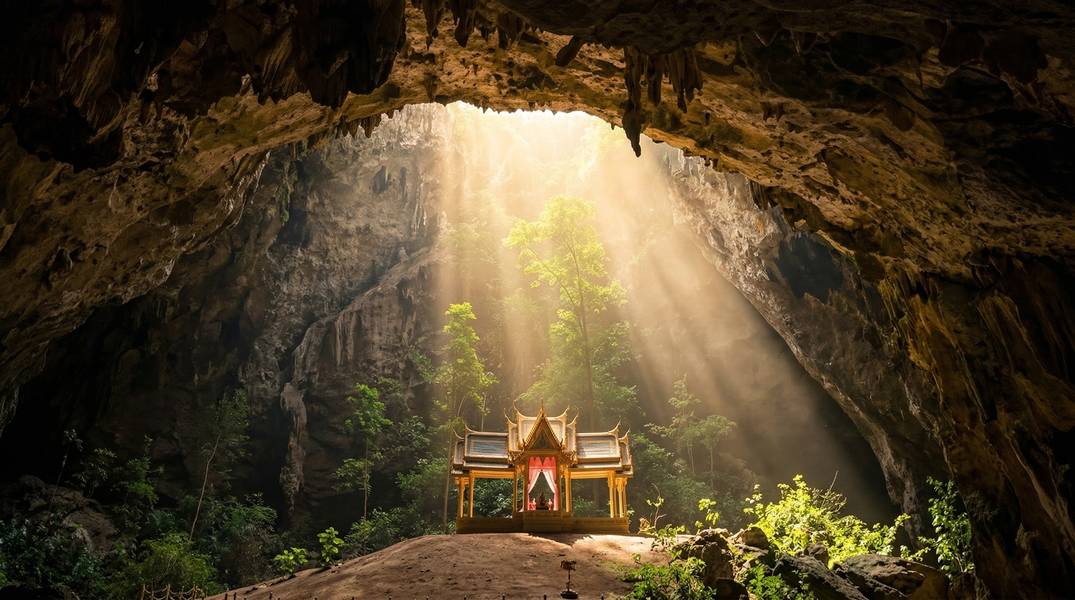
Deep within Khao Sam Roi Yot National Park — Thailand’s first coastal national park, established in 1966 — lies one of the country’s most iconic natural landmarks. Phraya Nakhon Cave is not a traditional cave but a pair of massive dolines (collapsed sinkholes), each 65 meters deep and 50 meters wide with overhanging walls draped in stalactites and tropical vegetation. At the heart of the second chamber stands the Kuha Karuhas Pavilion, a four-gabled royal pavilion in traditional Thai style built for King Rama V’s visit in 1890. When mid-morning sunlight streams through the collapsed ceiling, illuminating the pavilion in a shaft of light surrounded by ancient limestone walls, the effect is extraordinary.
The park name — Khao Sam Roi Yot, meaning “Mountain with Three Hundred Peaks” — describes the dramatic limestone karst hills rising from the coastal plain along the Gulf of Thailand. The 98 sq km park encompasses mixed deciduous forest, freshwater marshes, mangrove forests, sandy beaches, and Thailand’s largest remaining freshwater reedswamp — a Ramsar Wetland of International Importance.
For medical tourists, the cave trek itself is strenuous and unsuitable during recovery. However, the national park offers several excellent low-impact alternatives including flat boardwalks through wetlands, gentle mangrove trails, and seated canal boat tours — all within one of Thailand’s most biodiverse coastal environments.
Important: Park fees, trail conditions, and boat service availability are subject to change. Verify current information with the park office before your visit. Wildlife sightings cannot be guaranteed. The cave trail involves inherent physical risks.
Why Phraya Nakhon Cave is Special
Royal Heritage
The cave holds deep significance in Thai royal history. Discovered circa 1800 by Chao Phraya Nakhon Sri Thammarat — who reportedly sought shelter during a storm — the cave became a destination for Thai royalty:
- King Rama IV visited during a southern royal tour
- King Rama V (Chulalongkorn) visited multiple times between 1863-1890. The Kuha Karuhas Pavilion (พระที่นั่งคูหาคฤหาสน์) was built for his 1890 visit — a four-gabled structure in red and gold traditional Thai style, transported and assembled inside the cave by artisans from Bangkok
- King Rama VII (Prajadhipok) visited in 1926 and engraved his initials on the cave wall
- King Rama IX (Bhumibol Adulyadej) also visited the cave
The pavilion is so significant that it appears on the official seal of Prachuap Khiri Khan Province.
Geological Marvel
The cave’s two chambers are technically massive dolines — collapsed sinkholes with 65-meter-deep, 50-meter-wide openings and overhanging walls covered in plants and ancient stalactites. Notable geological features include:
- Ancient stalactites and stalagmites in the first chamber
- A dry waterfall of mineral deposits on the rock face
- A natural stone bridge at the top of one sinkhole — locally known as the “death bridge” because wild animals have fallen from it
- A natural skylight (karstfenster) in the cave ceiling that creates the iconic illumination effect
- Phraya Nakhon’s Well — a brick well (1m wide, 4m deep) attributed to the cave’s discoverer
- Trees and bushes growing inside the chambers, nourished by sunlight and rain entering through the open ceilings
Ecological Significance
Khao Sam Roi Yot National Park holds multiple conservation designations:
- Thailand’s first coastal national park (established 1966)
- Ramsar Wetland of International Importance — Thung Sam Roi Yot, the largest remaining freshwater reedswamp in Thailand (~7,000 ha)
- BirdLife International Important Bird Area (IBA) — 355+ bird species recorded, approximately half migratory
- Home to two endemic gecko species found nowhere else in the world: the Sam Roi Yot bent-toed gecko (Cyrtodactylus samroiyot) and the Sam Roi Yot leaf-toed gecko
Wildlife & Nature
What You Might See
Wildlife roams freely across the national park. Sightings depend on season, time, location, and luck.
| Animal | Best Time | Best Location | Conservation Status |
|---|---|---|---|
| Dusky langur / leaf monkey | Morning | Cave trail, forests | Least Concern |
| Crab-eating macaque | Daytime | Cave trail (common) | Least Concern |
| Fishing cat | Dawn/dusk | Marshes | Vulnerable |
| Southern serow | Early morning | Limestone cliffs | Vulnerable |
| Smooth-coated otter | Morning | Marshes, waterways | Vulnerable |
| Sunda slow loris | Night | Forest canopy | Vulnerable |
| Leopard cat | Night | Forests | Least Concern |
| Malayan porcupine | Night | Forests | Least Concern |
| Monitor lizards | Daytime | Trails, beaches | Least Concern |
| Dolphins | Daytime | Offshore | Various |
Note: Macaques are common on the cave trail and can be aggressive when food-conditioned. Do NOT feed macaques or any wildlife. Maintain safe distance and secure all food items.
Bird Watching
With 355+ recorded species — approximately half migratory — Khao Sam Roi Yot is one of Thailand’s premier birdwatching destinations. The park qualifies as a BirdLife IBA under multiple criteria, including supporting >1% of the Asian population of the Malaysian plover.
Notable Species:
| Category | Species |
|---|---|
| Raptors | Grey-headed fish eagle, white-bellied sea eagle, steppe eagle, western marsh harrier |
| Waterbirds | Asian openbill stork, painted stork, purple heron, oriental darter |
| Kingfishers | Black-capped, common, collared, pied, white-throated (5 species) |
| Shorebirds | Malaysian plover (Near-Threatened), oriental pratincole, spotted crake, jack snipe |
| Other | Long-billed partridge, lesser whistling-duck, bronze-winged jacana |
Best Birdwatching Periods:
- November-February: Peak migratory season — waterbirds on the Asia-Australia flyway
- January-February: Best months overall
- Year-round: Resident species active, especially early morning
Best Birdwatching Location: Bueng Bua Boardwalk (Thung Sam Roi Yot marsh) — flat, easy access, excellent for waterbird observation.
Flora & Ecology
The park protects a diverse range of habitats:
- Tropical forest inside cave chambers — trees and bushes nourished by sunlight through sinkholes
- Extensive freshwater reedswamp — nearly 7,000 ha, the largest in Thailand
- Mangrove forests along the coast
- Mixed deciduous woodland on limestone hills
Notable Plant Species:
- Afzelia xylocarpa (Endangered — IUCN)
- Burretiodendron esquirolii (Vulnerable — IUCN)
- Wrightia lanceolata (Vulnerable — IUCN)
Activities & Experiences
Cave Visit
The signature experience — reaching the Kuha Karuhas Pavilion illuminated by sunlight.
| Detail | Information |
|---|---|
| Trail Distance | 3.1 km round trip from Laem Sala Beach |
| Elevation Gain | 167m (steep stone stairs) |
| Difficulty | Moderate to challenging |
| Time | 1-1.5 hours round trip from beach |
| Best Light | 10:00 - 11:30 AM (sunlight on pavilion) |
| Guide Required | No |
| Post-Surgery Suitability | NOT suitable — strenuous hike with fall risk |
Warning: The trail is predominantly steep stone stairs over rocky, uneven terrain. Hand ropes on the steepest sections may be worn. A visitor was reportedly carried down on a stretcher with oxygen — this underscores the physical demands. Defibrillators are placed along the route. Flip-flops are absolutely NOT suitable — solid hiking shoes required.
Khao Daeng Viewpoint
| Detail | Information |
|---|---|
| Elevation | 157m peak |
| Difficulty | Moderate |
| Time | 20-30 minutes up |
| Surface | Rocky trail, partial shade |
| Highlights | 360-degree panorama, excellent sunset views |
| Post-Surgery Suitability | Moderate — uphill climbing, consult doctor |
Bueng Bua Boardwalk (Recommended for Recovery)
| Detail | Information |
|---|---|
| Distance | 1 km |
| Difficulty | Easy |
| Surface | Flat wooden boardwalk |
| Time | 30-45 minutes |
| Highlights | Waterbirds, marsh landscape, open views |
| Post-Surgery Suitability | Suitable for most recovery stages |
Mangrove Trail
| Detail | Information |
|---|---|
| Distance | 500m loop |
| Difficulty | Easy |
| Surface | Flat wooden walkway |
| Time | 20 minutes |
| Shade | Good mangrove canopy |
| Post-Surgery Suitability | Suitable for most recovery stages |
Khao Daeng Canal Boat Tour
| Detail | Information |
|---|---|
| Duration | ~1 hour |
| Difficulty | Easy (seated) |
| Cost | 500 THB per group (max 6 people) |
| Booking | Arranged on-spot |
| Best Time | Late afternoon for best light |
| Post-Surgery Suitability | Suitable for most recovery stages |
A mangrove waterway experience — excellent for birdwatching and late-afternoon photography without any walking.
Kaeo Cave Exploration
| Detail | Information |
|---|---|
| Trail Distance | 250m |
| Difficulty | Challenging — steep climb |
| Time | 30 minutes + cave exploration |
| Guide | Ranger guide required |
| Torch | Rental 40 THB |
| Post-Surgery Suitability | NOT suitable during recovery |
Other Activities
- Swimming at Laem Sala Beach and Sam Phraya Beach (no lifeguards — check conditions)
- Longtail boat rides around the cape
- Camping at Laem Sala Beach and Sam Phraya Beach
Trail Guide
Phraya Nakhon Cave Trail (from Laem Sala Beach)
The main trail to the cave — the park’s signature hike.
| Attribute | Detail |
|---|---|
| Distance | 3.1 km round trip (~430m final ascent) |
| Elevation Gain | 167m |
| Difficulty | Moderate to challenging |
| Surface | Rocky, uneven stairs; some sections with hand ropes |
| Shade | Mostly forested trail with good canopy cover |
| Time | 1-1.5 hours round trip |
| Rest Points | Informal rest stops, viewpoint halfway up |
| Facilities | Laem Sala Beach at trailhead |
Bang Pu to Laem Sala Overland Trail
The alternative to taking the boat — a strenuous hill crossing.
| Attribute | Detail |
|---|---|
| Distance | ~1.5 km over hill |
| Difficulty | Moderate (steep initial stairs) |
| Surface | Stone stairs and rocky trail |
| Shade | Forested |
| Time | 30-45 minutes one way |
Note: This is the most strenuous section of the approach. Visitors describe the initial climb as “quite difficult and tiring, starting with steep stairs that then turn into rocks.” The boat option is strongly recommended over this route.
Sai Cave Trail
| Attribute | Detail |
|---|---|
| Distance | 300m from road |
| Difficulty | Challenging — steep, rocky |
| Time | 30 minutes |
For Medical Tourists
Critical Advisory
The cave trek is NOT a recovery activity. It should only be attempted by fully recovered, physically fit individuals. The 430m ascent over steep, uneven stone stairs with 167m elevation gain poses significant fall risk and cardiovascular strain.
One visitor was evacuated on a stretcher with oxygen. Defibrillators are placed along the trail — the park takes cardiac events seriously.
Physical Requirements Assessment
| Factor | Level | Details |
|---|---|---|
| Walking Distance | 3.1 km RT | Plus boat/overland approach |
| Elevation Gain | 167m | Steep stone stairs throughout |
| Stairs | Extensive | Predominantly steep, uneven rock stairs |
| Temperature | High | Tropical heat, no breeze on forested trail |
| Humidity | Very high | Inside cave chambers extremely humid |
| Shade | Good on trail | Exposed inside cave (sunlight through sinkholes) |
| Rest Areas | Informal | Viewpoint halfway; Laem Sala Beach at base |
| Mobile Signal | Limited | Better at Bang Pu village and park HQ |
| Wheelchair Access | None | Absolutely not accessible |
Post-Surgery Suitability
| Procedure Type | Cave Trek | Boardwalk / Mangrove | Canal Boat |
|---|---|---|---|
| Dental (simple) | ❌ Not recommended | ✅ Week 1+ | ✅ Week 1+ |
| Minor cosmetic | ❌ Not recommended | ✅ Week 1-2 | ✅ Week 1-2 |
| LASIK | ❌ Not recommended | ✅ Week 2+ | ✅ Week 2+ |
| Orthopedic (minor) | ❌ Not recommended | ⚠️ Week 3+ | ✅ Week 2+ |
| Abdominal surgery | ❌ Not recommended | ⚠️ Week 3+ | ✅ Week 2+ |
| Cardiac procedures | ❌ Dangerous | ⚠️ Doctor approval | ✅ Week 3+ |
| Hip/knee replacement | ❌ Dangerous | ⚠️ Doctor approval | ✅ Week 3+ |
| Major surgery | ❌ Strictly not recommended | ⚠️ Doctor approval | ⚠️ Doctor approval |
Recommended Recovery Activities in the Park
Medical tourists visiting Khao Sam Roi Yot should focus on these accessible, therapeutic alternatives:
-
Bueng Bua Boardwalk — 1 km flat wooden boardwalk through Thailand’s largest freshwater marsh. Excellent birdwatching (355+ species). Gentle, shaded, and restorative.
-
Mangrove Trail — 500m flat walkway through mangrove forest with good canopy shade. Easy and peaceful.
-
Khao Daeng Canal Boat Tour — 1 hour seated boat ride through mangrove waterways. No walking required. Best in late afternoon light.
-
Beach Relaxation at Laem Sala — If boat access is available, the beach offers calm waters and scenery without any hiking.
Medical Advisory: Consult your treating physician before any outdoor activities post-surgery. The park’s remote location means the nearest hospital (Sam Roi Yot Hospital) is approximately 15-20 km from the cave trailhead. Mobile signal is limited at the cave and on trails.
Nearest Hospitals
| Hospital | Distance from Cave | Travel Time | Type |
|---|---|---|---|
| Sam Roi Yot Hospital | ~15-20 km | ~20-30 min | Community (basic) |
| Pran Buri Hospital | ~30 km | ~30-40 min | District |
| Prachuap Khiri Khan Hospital | ~50 km south | ~50-60 min | Provincial (more equipped) |
| Hua Hin Hospital | ~70 km north | ~1-1.5 hours | General |
Emergency Contacts:
- National Emergency: 1669
- Tourist Police: 1155
- Park Office: +66 32 821 568
Getting There
From Bangkok by Car
| Detail | Information |
|---|---|
| Distance | ~280 km |
| Duration | 3.5-4 hours |
| Route | Phetkasem Road (Highway 4) south |
A car or private transfer is recommended as there is no public transport to the cave trailhead.
From Hua Hin
| Detail | Information |
|---|---|
| Distance | ~55 km south |
| Duration | ~45 minutes |
| Route | Highway 4 south to Sam Roi Yot |
Many visitors base in Hua Hin and day-trip to the park.
Public Transport
| Step | Option | Duration | Cost |
|---|---|---|---|
| Bangkok → Pranburi | Minivan from Southern Bus Terminal (Sai Tai Mai) | 4-5 hours | ~300 THB |
| Bangkok → Hua Hin/Wang Phong | State Railway of Thailand | ~4 hours | 100-1,100 THB |
| Hua Hin → Bang Pu | Taxi, Grab, or songthaew | ~45 min | ~1,500 THB RT (driver waits) |
Private Transfer
| From | Duration | Cost |
|---|---|---|
| Bangkok | ~3.5 hours | 2,500-4,000 THB |
| Hua Hin | ~45 minutes | ~1,500 THB round trip (driver waits) |
Last Mile: Bang Pu to Cave
No public transport runs to the cave trailhead. From Bang Pu village:
Option 1 — Longtail Boat (Recommended):
- Bang Pu → Laem Sala Beach: 5-10 minute ride
- Cost: 150-200 THB per person round trip (varies by season and group size)
- Bypasses the steep overland hill climb
- May not operate during rough seas (monsoon season)
Option 2 — Overland Trail:
- ~1.5 km over a steep hill
- 30-45 minutes one way
- Strenuous — steep stairs then rocky terrain
- Free but physically demanding
Parking: Available at Bang Pu village trailhead.
Prices subject to change. Boat costs vary by season, group size, and operator (150-400 THB range reported across sources).
Accommodation
Inside the Park
Park Rooms (near headquarters):
- 1,000-1,400 THB per night (sleeps up to 5 people)
Laem Sala Beach Rooms (at cave trailhead):
- 1,600-2,200 THB per night (sleeps 6-9 people)
Camping at Laem Sala Beach and Sam Phraya Beach:
- Own tent: Park entry fee only
- Tent rental: 150 THB (2 people), 225 THB (3), 300 THB (4)
- Accessories: Pillow 10 THB, blanket 10 THB, sleeping bag 30 THB, sheet 20 THB
Booking: DNP online booking system or walk-in at headquarters.
Tip: Book Laem Sala Beach accommodation in advance during peak season (December-February). Staying overnight at the park allows earliest cave access for the best morning light on the pavilion.
Nearby Options
Luxury:
- Aleenta Hua Hin Pranburi — 5-star, ~8 miles from park
- Wyndham Hua Hin Pranburi Resort & Villas — 5-star, ~10 miles
Mid-Range:
- La Isla Pranburi Beach Resort — 5-minute drive from park
- Hansar Pranburi Resort — near Sam Roi Yot Beach
- Dolphin Bay Beach Resort — 3-star beachfront, 5-mile beach
Budget:
- The Green Beach Resort — mid-range, 8.9/10 rating
- Blue Beach Resort — from ~$22/night
- Stella Resort — from ~$45/night
- Various homestays and guesthouses in Sam Roi Yot and Pranburi
Practical Tips
What to Bring
Essential:
- Sturdy hiking shoes with good grip (flip-flops are NOT suitable for the cave trail)
- Minimum 1.5L water per person (limited water sources on trail)
- Sun protection: hat, sunscreen, sunglasses
- Insect repellent (mosquitoes present near forest and marsh)
- Camera (for the iconic pavilion illumination)
- Cash (THB) — QR payment unconfirmed at remote stations
- Offline maps (limited mobile signal)
Rainy Season (May-November):
- Rain jacket and waterproof bag for electronics
- Extra grip footwear — trails become very slippery
- Change of clothes
- Leech protection (possible in wet forested areas)
For Recovery Patients (boardwalk/boat activities):
- Prescribed medications
- Hospital contact card with emergency numbers
- Cooling towel or portable fan
- Light snacks and electrolyte drinks
- Comfortable walking shoes (for boardwalk)
What NOT to Bring
Since April 2022, the following are banned in Thai national parks with fines up to 100,000 THB:
- Single-use plastic bags (under 36 microns)
- Styrofoam/foam containers
- Single-use plastic cups, straws, and cutlery
Plastic water bottles are not explicitly banned but refillable bottles are encouraged.
Wildlife Safety
- Macaques: Very common on the cave trail. Do NOT feed them — they become aggressive when food-conditioned. Secure all food and bags.
- Snakes: 14 species recorded in the park including South Asian bockadam in mangroves. Stay on marked trails, watch your step on forested paths.
- Monitor lizards: Generally harmless but maintain distance.
Heat & Hydration
- The forested cave trail has no breeze and tropical humidity
- Inside the cave can be extremely humid
- Bring more water than you think you need
- Start early (arrive by 8:00 AM) to avoid midday heat
- Take breaks at rest points — there is no shame in turning back
Environmental Responsibility
Park Rules
Khao Sam Roi Yot is a protected national park with multiple conservation designations. Follow these rules:
- No feeding wildlife — Macaques become aggressive and dependent
- No touching stalactites, stalagmites, or cave walls — including royal inscriptions
- No littering — Pack out all trash; leave no trace
- Stay on marked trails — Protects vegetation and your safety
- No drones without prior written permission from park administration
- No single-use plastics — Banned since April 2022 (fines up to 100,000 THB)
Ethical Wildlife Guidelines
- Observe wildlife from a safe distance
- Never approach, corner, or chase animals
- Do not use flash photography near wildlife
- Report injured animals to park rangers
- Support the park’s conservation mission by following all regulations
Conservation Context
This park protects critical habitats:
- Thailand’s largest freshwater reedswamp (Ramsar-designated)
- Breeding grounds for globally threatened bird species
- Endemic species found nowhere else (Sam Roi Yot geckos)
- Major threats include habitat conversion to aquaculture and commercial duck rearing pollution
Seasonal Guide
Month-by-Month Conditions
| Month | Weather | Cave Visit | Medical Tourist Rating |
|---|---|---|---|
| January | Dry, warm | Excellent — peak migratory birdwatching | Excellent |
| February | Dry, warm | Excellent — clear skies for cave photography | Excellent |
| March | Dry, hot | Very good — trails dry, increasing heat | Good |
| April | Hot, dry | Good but very hot; Songkran crowds possible | Fair (heat caution) |
| May | Monsoon begins | Trail slippery; boat may be unavailable | Not recommended |
| June | Monsoon, humid | Trail slippery; lush vegetation | Not recommended |
| July | Intermittent rain | Cave accessible but trails challenging | Not recommended |
| August | Moderate rain | Trails slippery; fewer tourists | Not recommended |
| September | Peak rainfall | Trails very slippery; not recommended for casual visitors | Not recommended |
| October | Heavy rain continues | Trail conditions poor; boat service unreliable | Not recommended |
| November | Monsoon ending | Transitional; birdwatching improving | Good (late month) |
| December | Dry season begins | Excellent — good weather, migratory birds | Excellent |
Best Months for Specific Activities
| Activity | Best Months | Notes |
|---|---|---|
| Cave visit (pavilion illumination) | Nov-Apr | Dry trails, clear skies for light effect |
| Birdwatching | Nov-Feb | Peak migratory season, waterbirds on Asia-Australia flyway |
| Photography | Jan-Feb | Clear skies, best light at 10:00-11:30 AM in cave |
| Hiking trails | Nov-Apr | Dry conditions, manageable heat |
| Beach relaxation | Nov-Apr | Calm seas, boat service reliable |
| Mangrove/boardwalk | Year-round | Easy activities in all conditions |
Migratory Bird Calendar
November-February: Peak migratory bird season. Waterbirds travel the Asia-Australia flyway and congregate in the park’s freshwater marsh. January and February offer the best birding.
Nearby Attractions
Within the Park
| Attraction | Distance | Difficulty | Notes |
|---|---|---|---|
| Kaeo Cave | Separate trail | Challenging | Ranger guide required, torch rental 40 THB |
| Sai Cave | 300m from road | Challenging | Rocky, steep trail |
| Khao Daeng Viewpoint | Short hike | Moderate | 360-degree panorama, excellent sunset |
| Bueng Bua Boardwalk | Near HQ | Easy | 1 km flat boardwalk, Thailand’s largest freshwater marsh |
| Mangrove Trail | Near HQ | Easy | 500m flat walkway, observation tower |
| Khao Daeng Canal | Near HQ | Easy (boat) | Mangrove boat tour, 500 THB/group |
| Laem Sala Beach | At cave trailhead | Easy | Swimming, relaxation |
| Sam Phraya Beach | Within park | Easy | Swimming, camping |
Beyond the Park
| Attraction | Distance | Description |
|---|---|---|
| Kui Buri National Park | ~60 km south | Wild elephant watching — one of Thailand’s best |
| Pranburi Forest Park | ~30 km north | Mangrove boardwalk, easy coastal walk |
| Khao Luang Cave, Phetchaburi | ~80 km north | Golden Buddha images inside a cave with stalactites |
| Hua Hin | ~55 km north | Beaches, royal palace, night market, hospitals |
| Cicada Market (Hua Hin) | ~55 km north | Art and food market |
Local Food & Markets
- Seafood restaurants in Bang Pu village and Sam Roi Yot town
- Extensive dining options in Hua Hin (~55 km north)
- Hua Hin Night Market — local food, souvenirs
- Local fresh markets in Sam Roi Yot
Historical Significance
Discovery & Royal Patronage
The cave was discovered circa 1800 during the reign of King Rama I by Chao Phraya Nakhon Sri Thammarat, who sought shelter during a storm. He reportedly constructed a brick well (1m wide, 4m deep) inside the cave, now known as “Phraya Nakhon’s Well.”
The Kuha Karuhas Pavilion
The pavilion — พระที่นั่งคูหาคฤหาสน์ (Kuha Karuhas) — is a four-gabled royal structure in traditional Thai architectural style, decorated in red and gold. Built by artisans from Bangkok who transported and assembled it inside the cave for King Rama V’s visit. The first chamber also contains a Hindu shrine built in 1890 by order of King Rama V.
Royal inscriptions on the cave walls include the initials of King Rama V and King Rama VII. Pottery found inside the cave is believed to be over 200 years old.
The pavilion is the defining symbol of Prachuap Khiri Khan Province and appears on the official provincial seal.
Related Nature Destinations
Similar Experiences
- Kaeng Krachan National Park — Thailand’s largest national park, UNESCO World Heritage, excellent birdwatching, 2.5 hours from Bangkok
- Khao Yai National Park — Thailand’s first national park, UNESCO World Heritage, accessible wildlife viewing, 2.5 hours from Bangkok
- Khao Luang Cave (Phetchaburi) — Golden Buddha images illuminated by sunlight in a cave setting, ~80 km north
By Recovery Stage
| Recovery Stage | Recommended Activities |
|---|---|
| Week 1-2 | Bueng Bua Boardwalk, mangrove trail, canal boat tour |
| Week 3-4 | Add Khao Daeng Viewpoint (moderate), beach relaxation |
| Week 6+ (fully recovered) | Cave trek (with doctor approval), full trail exploration |
Disclaimer: Outdoor activities involve inherent risks. Weather conditions, trail conditions, and wildlife behavior are unpredictable. The cave trail is physically demanding with steep, uneven stairs and significant elevation gain. Medical tourists should consult their physician before visiting. Park fees, hours, boat service availability, and regulations may change without notice. Wildlife sightings cannot be guaranteed. Nature experiences are described for wellbeing and enjoyment — they are not medical treatments.
Frequently Asked Questions
Is Phraya Nakhon Cave safe to visit after surgery?
The cave trail is NOT suitable for recovering surgical patients. It requires significant physical exertion including steep stair climbing over rocky, uneven terrain with 167m elevation gain. A visitor was once evacuated on a stretcher with oxygen. However, Khao Sam Roi Yot National Park offers excellent easy alternatives: Bueng Bua Boardwalk (flat, great birdwatching), Mangrove Trail (flat walkway), and the Khao Daeng canal boat tour (seated). These are suitable from Week 2 post-procedure. Consult your doctor before any outdoor activities.
What is the best time to see the sunlight on the pavilion?
The sunlight illuminates the Kuha Karuhas Pavilion most dramatically between 10:00 and 11:30 AM, when the sun is positioned to shine directly through the cave's collapsed sinkhole ceiling. Arrive at Laem Sala Beach by 8:00 AM to allow time for the hike. The effect is best during dry season (November-April) when skies are clearest.
How physically demanding is the hike to the cave?
Moderate to challenging. The total round trip is 3.1 km with 167m elevation gain over steep, uneven stone stairs. Allow 1-1.5 hours from Laem Sala Beach to the cave and back. The trail is mostly forested with good shade but extremely humid with no breeze. Solid hiking shoes are essential — flip-flops are not suitable. Defibrillators are placed along the route.
Do I need to take a boat to reach the cave?
You have two options: (1) Take a longtail boat from Bang Pu village to Laem Sala Beach (5-10 minutes, 150-200 THB per person round trip) — this is easier and bypasses the steep overland hill. (2) Hike overland from Bang Pu to Laem Sala Beach (~1.5 km over a steep hill, 30-45 minutes). Both routes lead to the beach where the cave trail begins. Boats may not operate during rough seas in monsoon season.
Is there mobile phone signal at the cave?
Mobile signal is likely limited or intermittent at the cave and on trails. Better signal is available at Bang Pu village and park headquarters. Download offline maps before your visit and inform someone of your plans. The park has rangers present at trailheads.
Can I visit during rainy season?
The cave is open year-round, but visiting during monsoon season (May-November) is not recommended for most visitors. Trails become very slippery, boat service may be suspended in rough seas, and the heaviest rainfall occurs September-November. If you do visit, exercise extreme caution on the wet stairs.
What are the park entry fees?
Foreign adults 200 THB, foreign children 100 THB. Thai adults 40 THB, Thai children 20 THB. Additional costs include longtail boat from Bang Pu to Laem Sala Beach (150-200 THB per person round trip). Cash is recommended as QR payment availability is unconfirmed at remote park stations. Fees are subject to change without notice.
Are guides required for the cave?
No guide is required for Phraya Nakhon Cave — the trail is self-guided. However, a ranger guide is required for Kaeo Cave (another cave within the park), with torch rental available for 40 THB.
Can I camp near the cave?
Yes. Camping is available at Laem Sala Beach (at the cave trailhead) and Sam Phraya Beach. Tent rental: 150 THB (2 people), 225 THB (3 people), 300 THB (4 people). Accessories available: pillow 10 THB, blanket 10 THB, sleeping bag 30 THB. Book via DNP online booking system or walk-in at park headquarters.
Need Help Planning Your Visit?
Our team can help coordinate your visit to Phraya Nakhon Cave during your stay in Thailand.
Check your insurance coverage before booking your medical trip.