
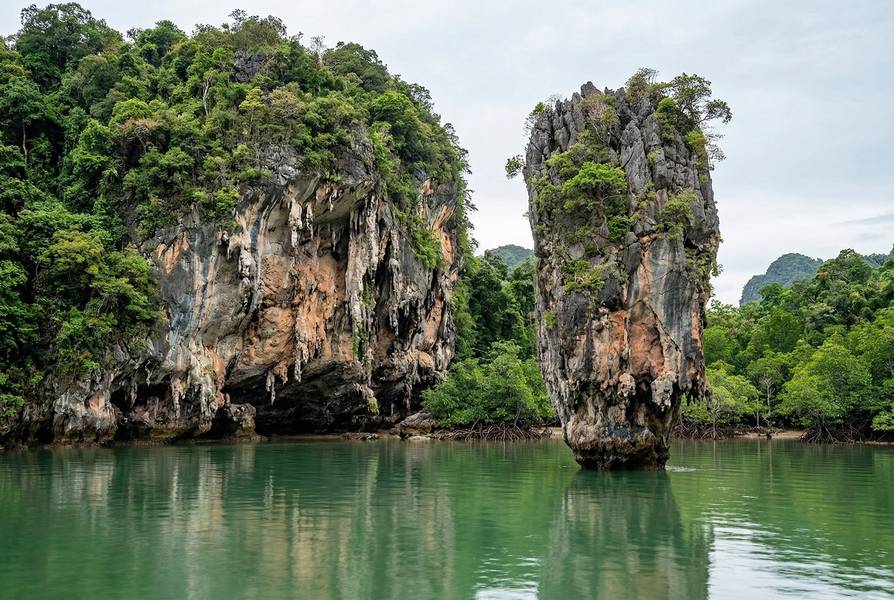
Ao Phang Nga National Park
Overview
อุทยานแห่งชาติอ่าวพังงา • Ao Phang Nga National Park
Ao Phang Nga National Park protects 400 sq km of shallow, emerald-green bay in the Strait of Malacca, where 42 limestone tower karst islands rise dramatically from the water. Established in 1981, the park is internationally recognized as a Ramsar Wetland of International Importance and an ASEAN Heritage Park, and appears on the UNESCO World Heritage Tentative List as part of the Andaman Sea Nature Reserves (submitted 2021).
The bay is best known for Khao Ta Pu—the 20-meter vertical needle karst made famous as the villain’s hideout in the 1974 James Bond film The Man with the Golden Gun. But beyond the iconic pinnacle, the park shelters Thailand’s largest remaining expanse of native mangrove forest (~210 sq km), sea-level caves connecting to enclosed interior lagoons called hongs, and one of southern Thailand’s richest birdwatching destinations with approximately 180 recorded species.
For medical tourists visiting Thailand, Ao Phang Nga offers an accessible nature experience: the primary mode of exploration is by boat, requiring minimal physical exertion. Longtail boat tours are essentially passive, making this one of the most suitable nature parks for patients in early recovery.
Park fees, operating hours, and seasonal conditions are subject to change without notice. Verify current information through the official DNP website or your tour operator before booking.
History & Significance
Park Establishment
- 1981: Established as Ao Phang Nga National Park covering 400 sq km (250,000 rai)
- 2002: Designated as a Ramsar Wetland of International Importance (Site No. 1185)
- ASEAN Heritage Park: Joint designation with Mu Ko Surin and Mu Ko Similan
- 2021: Submitted to UNESCO World Heritage Tentative List (Andaman Sea Nature Reserves)
- 2025: E-ticket system introduced for park entry
Koh Panyi — A Living Community
Within the park boundaries sits Koh Panyi (เกาะปันหยี), a remarkable floating Muslim village founded in the late 18th century (~1790s) by nomadic Javanese (Bugis) fishermen led by Toh Baboo. Today, approximately 1,600 residents in 360 families live in stilted structures over the water.
The village is NOT administered by the national park but sits within its boundaries. Built on stilts because Thai law historically prohibited foreign land ownership, the village takes its name from the Malay “Pulau Panji” (Flag Island).
Notable landmarks:
- Dar Al Salam Mosque (focal point of the village)
- Floating football pitch (built 1986 from fishing scraps—internationally famous)
- Muslim school and freshwater well on the rock
Cultural etiquette: Dress modestly near the mosque. Ask permission before photographing residents. The village is a living community, not a theme park.
Natural Features & Ecology
Landscape & Geology
The bay features shallow, emerald-green waters sheltered by the mainland, creating calm conditions even during monsoon season. Geological formations include:
- 42 limestone tower karst islands rising 20-300 meters from the water surface
- Khao Ta Pu (James Bond pinnacle)—a 20-meter vertical needle karst
- Sea-level caves and hongs—enclosed interior lagoons accessible only by kayak at specific tides
- Tidal flats and estuarine wetlands
- Prehistoric rock paintings at Nak Cave and Tham Sam Rock Art site
Cave Systems
| Cave | Length | Notable Features |
|---|---|---|
| Ice Cream Cave | 120 m | Formations resembling ice cream |
| Phanak Cave | 253 m | Part of 11-cave system on Phanak Island |
| Diamond Cave | 70 m | Stalactites and stalagmites |
| Oyster Cave | 50 m | Fossil oyster shells |
| Khang Khao Cave | 150 m | Bat colonies |
| Mangrove Cave | 100 m | Mangrove-surrounded entrance |
| Lot Nai Cave | 110 m | Boat-passable |
| Nak Cave | 50 m | Prehistoric rock paintings |
Mangrove Forest
Ao Phang Nga protects the largest intact mangrove forest in Thailand (~210 sq km) with 28+ species including:
- Rhizophora apiculata (tall-stilted mangrove)
- Rhizophora mucronata (loop-root mangrove)
- Avicennia alba (white mangrove)
- Xylocarpus granatum (cannonball mangrove)
- Xylocarpus moluccensis (cedar mangrove)
Wildlife
Mammals:
- Crab-eating macaque (Macaca fascicularis)—common on islands
- Dusky langur / Dusky leaf monkey (Trachypithecus obscurus)
- Smooth-coated otter (Lutrogale perspicillata)—declining, conservation concern
- Oriental small-clawed otter (Aonyx cinereus)
- Dugong (Dugong dugon)—increasingly sighted 2024-2025 as populations migrate into bay waters
Reptiles:
- Clouded monitor (Varanus nebulosus)
- Bengal monitor lizard (Varanus bengalensis)
- Reticulated python (Malayopython reticulatus)
- Banded sea snake (Laticauda colubrina)—present but rarely aggressive
- Mangrove pit viper (Trimeresurus purpureomaculatus)
Marine Life:
- Green sea turtle (Chelonia mydas)—nesting on nearby beaches
- Hawksbill turtle (Eretmochelys imbricata)
- Finless porpoise (Neophocaena phocaenoides)
- 82+ fish species recorded
- Horseshoe crabs, fiddler crabs, mudskippers
Birdwatching
Ao Phang Nga is one of the premier mangrove birdwatching sites in southern Thailand with approximately 180 species recorded. The park HQ area and Phang Nga Town mangrove walkway—not the main tourist boat routes—are the primary birding locations.
Star Species:
- Mangrove Pitta (Pitta megarhyncha)—year-round resident, activity is tide-dependent
- Brown-winged Kingfisher (Pelargopsis amauroptera)—best site in southern Thailand
- Seven kingfisher species at one location (an exceptional concentration)
Other Notable Birds:
- White-bellied Sea Eagle (Haliaeetus leucogaster)
- Brahminy Kite (Haliastur indus)
- Oriental Pied Hornbill (Anthracoceros albirostris)
- Great Hornbill (Buceros bicornis)
- Buffy Fish Owl (Ketupa ketupu)
- Ruddy Kingfisher, Stork-billed Kingfisher, Common Kingfisher, White-throated Kingfisher, Collared Kingfisher, Black-capped Kingfisher
- Mangrove Blue Flycatcher, Mangrove Whistler, Ashy Tailorbird
- Malaysian Plover (Anarhynchus peronii)—globally threatened
- Asiatic Dowitcher (Limnodromus semipalmatus)—globally threatened, migratory (Oct-Apr)
Wildlife sightings are never guaranteed. Marine and bird species are wild and unpredictable. Seasonal conditions, tides, weather, and time of day all affect visibility.
Conservation
- Coral bleaching detected in 2024 across 19 national parks including Ao Phang Nga
- Dugong populations are migrating from Trang/Krabi into Phang Nga Bay due to seagrass die-off in traditional habitats
- DMCR 800,000 sq m seagrass restoration project underway at Phang Nga-Phuket sites
- Fodor’s Travel 2018 “No List” inclusion due to overtourism concerns—visitor management improvements ongoing
- John Gray’s Sea Canoe has pioneered eco-tourism in the bay since 1983
Activities & Experiences
Sea Kayaking / Canoeing
| Aspect | Details |
|---|---|
| Difficulty | Easy to moderate (guided tandem kayaks available) |
| Duration | 2-4 hours as part of tour |
| Highlights | Cave exploration, hidden hongs (lagoons), mangrove channels |
| Post-Surgery | Moderate—requires some upper body movement; guided tandem kayaks reduce demand |
Kayaking through sea-level caves into enclosed hongs is the park’s premier activity. Access is tide-dependent—your guide manages timing for safe entry and exit. Never enter caves without an experienced guide; risk of entrapment at high tide.
Longtail Boat Touring
| Aspect | Details |
|---|---|
| Difficulty | Easy (passive) |
| Duration | 4-6 hours |
| Highlights | James Bond Island, Koh Panyi, karst scenery, cave viewing |
| Post-Surgery | Excellent—mostly seated, suitable for early recovery |
The most accessible way to explore. Passengers sit in the boat with stops at islands for short walks (50-200 m). Stepping in and out of boats requires some mobility and assistance may be needed.
Speedboat Touring
| Aspect | Details |
|---|---|
| Difficulty | Easy (passive, but bumpy) |
| Duration | 4-5 hours |
| Highlights | Faster coverage, same major stops |
| Post-Surgery | Poor for recent surgery—impact from waves on healing tissues |
Faster but rougher ride. Not recommended for patients with recent surgery, abdominal procedures, or conditions aggravated by jarring movement.
Mangrove Boardwalk Trails
| Trail | Distance | Difficulty | Time | Features |
|---|---|---|---|---|
| Mangrove Nature Walkway (near Phang Nga Town) | ~1 km | Easy | 30-60 min | Flat boardwalk, full canopy shade, Mangrove Pitta territory |
| Park HQ Mangrove Walkway | ~500 m | Easy | 20-40 min | Flat boardwalk, Brown-winged Kingfisher hotspot |
| Baan Bang Phat Mangrove Nature Trail | ~1.5 km | Easy | 45-60 min | Boardwalk and packed earth, community-based trail |
All trails are flat with raised wooden boardwalks. Full shade from mangrove canopy. Excellent for gentle recovery walks and birdwatching.
Wildlife Watching
Best Species to Look For:
- Mangrove Pitta (year-round, activity correlates with tidal changes)
- Brown-winged Kingfisher (year-round, park HQ area)
- Seven kingfisher species total across the park
- White-bellied Sea Eagle (soaring over bay)
- Crab-eating macaques on islands
- Smooth-coated otters in mangrove channels
- Dugongs (increasingly reported 2024-2025)
- Mudskippers and fiddler crabs on exposed mangrove roots
Best Times: Dawn and dusk for birdwatching. Mangrove Pitta is most active with tidal changes. November-April for optimal overall conditions.
Photography
Best Spots:
- Khao Ta Pu (James Bond Island pinnacle) from Khao Phing Kan beach
- Koh Panyi floating village—aerial or boat-level perspectives
- Interior hongs at golden hour (kayak access)
- Mangrove channels—reflections and root systems
- Karst silhouettes at sunset from western bay viewpoints
Sunrise: ~06:15 | Sunset: ~18:15 (varies by season). Best sunset shots from the western side of the bay.
Other Activities
- Cave exploration (boat-based, guided only)
- Cultural visit to Koh Panyi floating village
- Prehistoric rock art viewing at Nak Cave
- Multi-day sea canoe expeditions (2-3 day tours available through specialized operators)
For Medical Tourists
Physical Requirements Assessment
| Factor | Level | Details |
|---|---|---|
| Boat Transfer | Easy | 1.5-2 hours by big boat, 45 min by speedboat from Phuket piers |
| Boarding/Disembarking | Moderate | Stepping in/out of boats at island stops—assistance available |
| Beach Walking | Easy | Short walks (50-200 m) at island stops |
| Kayaking | Easy-Moderate | Guided tandem kayaks reduce upper body demand |
| Mangrove Boardwalks | Easy | Flat, raised boardwalks with full shade |
| Heat Exposure | Moderate-High | Limited shade on open water; good shade on boardwalks |
| Mobile Signal | Variable | Good at piers and Koh Panyi; limited at remote islands/caves |
Post-Surgery Suitability
| Procedure Type | Longtail Boat Tour | Kayaking | Speedboat Tour |
|---|---|---|---|
| Dental (extraction/implant) | Week 1-2+ | Week 3+ | Week 3+ |
| Light cosmetic (Botox, fillers) | Week 1-2+ | Week 3+ | Week 3+ |
| Rhinoplasty | Week 2-3+ | Week 4+ | NOT recommended |
| Orthopedic (upper body) | Week 2-3+ | NOT until cleared | Week 3+ |
| Orthopedic (lower body) | Week 2-3+ (assist boarding) | NOT until cleared | Week 3+ |
| Abdominal surgery | Week 4-6+ | NOT recommended | NOT recommended |
| Cardiac procedures | Week 3+ (with doctor approval) | NOT recommended | NOT recommended |
All timelines are general guidance only. Individual recovery varies significantly. Always consult your treating doctor before any outdoor activities post-procedure.
Medical Advisory: While Ao Phang Nga is more accessible than most nature parks, boat access requires stepping on and off vessels. Speedboat impact can affect healing tissues. There are no medical facilities within the park. The nearest hospital (Phang Nga Hospital) is approximately 25 km / 30-40 minutes by road from the park HQ pier. Always carry your hospital contact card and any prescribed medications.
Who This Destination Suits Best
- Patients 1-2+ weeks post minor procedures seeking gentle nature experiences
- Those wanting boat-based sightseeing with minimal walking
- Birdwatching and photography enthusiasts in recovery
- Patients comfortable with limited mobile signal at some locations
Who Should Exercise Caution
- Patients with recent abdominal or cardiac surgery (boat boarding movements)
- Anyone unable to step in/out of boats without significant difficulty
- Patients requiring immediate access to medical facilities
- Those with severe motion sensitivity (open water, even calm, may cause discomfort)
Nearest Hospitals
| Hospital | Location | Distance from Park HQ | Travel Time |
|---|---|---|---|
| Phang Nga Hospital | Phang Nga Town | ~25 km | 30-40 min by road |
| Bangkok Hospital Phuket | Phuket Town | ~75 km | ~1.5 hours |
| Phuket International Hospital | Phuket Town | ~75 km | ~1.5 hours |
Emergency from Bay: Radio to tour boat → Boat to pier → Road transport to hospital
Emergency Numbers:
- 1669: National Emergency Hotline
- 1155: Tourist Police
- Park Rangers: (+66) 76 481 188, (+66) 76 481 163
Getting There
From Bangkok
- Fly to Phuket International Airport (HKT)—1.5 hours, 15+ daily flights
- Transfer by road to departure pier (45-60 minutes to Ao Po Pier)
- Boat to park (1.5-2 hours by big boat, 45 min by speedboat)
Alternative: Fly to Krabi Airport (1.5 hours from Bangkok, 5+ daily flights) and access from the Krabi side via Nopparat Thara Pier.
Bus: Bangkok Southern Terminal → Phang Nga Bus Station (~12 hours, overnight buses available). From Phang Nga bus station, taxi/songthaew to pier.
Departure Piers
| Pier | Location | Distance from Phuket Airport | Notes |
|---|---|---|---|
| Ao Po Pier | Phuket (northeast) | ~35 km | Most popular for day tours |
| Bang Rong Pier | Phuket (northeast) | ~14 km | Closest to airport |
| Tha Dan Pier (Park HQ) | Phang Nga mainland | ~60 km from Phuket airport | Official park starting point |
| Rassada Pier | Phuket Town | ~29 km from airport | Large ferry terminal |
| Nopparat Thara Pier | Krabi | — | Alternative from Krabi side |
Tour Options
Most visitors explore Ao Phang Nga as a day trip from Phuket, Krabi, or Khao Lak. Hotel pickup is included in most organized tours.
| Tour Type | Price Range (THB) | Duration | Best For |
|---|---|---|---|
| Group day tour | 1,500-2,500 | 6-8 hours | Budget travelers |
| Private longtail charter | Varies by route | Flexible | Customized pace |
| John Gray’s Sea Canoe | ~3,950 per person | Full day or evening | Eco-tourism, crowd-free experience |
John Gray’s Sea Canoe (established 1983) is the original eco-kayaking operator in Phang Nga Bay. Their “Hong by Starlight” evening tour includes a bioluminescent paddle and avoids daytime crowds.
Private taxi Phuket Airport → Ao Po Pier: approximately 800-1,200 THB, 45-60 minutes.
Road conditions: Good paved roads from Phuket to all piers. Route 4 (Phetkasem) connects Phang Nga Town to mainland piers.
Accommodation
In the Park
No DNP-managed accommodation (bungalows or camping) is available at this park. Overnight stays within the bay are possible only through:
- Koh Panyi village: Basic guesthouses on the floating village (budget). Staying overnight offers an authentic, crowd-free experience after day-trippers leave.
- Licensed tour operators: Some multi-day kayak expeditions include overnight beach camping.
Nearby Options
| Location | Distance | Range | Best For |
|---|---|---|---|
| Koh Yao Noi | 30 min by boat | Mid-range to luxury | Best base for bay exploration, boutique resorts |
| Koh Yao Yai | 30 min by boat | Mid-range | Quieter island alternative |
| Phang Nga Town | ~25 km by road | Budget to mid-range | Local experience, hotels and guesthouses |
| Natai Beach | ~30 km by road | Luxury | Aleenta, Point Yamu, and similar resorts |
| Phuket | 1-1.5 hours to piers | Full range | Widest selection, most medical facilities nearby |
Booking tip: For overnight in the bay, Koh Yao Noi offers the best balance of accessibility and atmosphere. Most visitors explore as a day trip from Phuket.
Practical Tips
What to Pack
Essential:
- Reef-safe mineral sunscreen (zinc oxide/titanium dioxide)
- Hat and sunglasses (limited shade on boats)
- Lightweight, breathable clothing
- Water shoes or sandals with grip (slippery rocks at island stops)
- Insect repellent (mosquitoes in mangrove areas, especially at dusk)
- Reusable water bottle
- Waterproof bag for electronics
- Cash (THB) for park fees and village purchases
For Recovery Patients:
- Hospital contact card with emergency numbers
- Prescribed medications
- Cooling towel
- Motion sickness medication (if prone)
What NOT to Bring
| Prohibited Item | Consequence |
|---|---|
| Chemical sunscreen | Up to 100,000 THB fine |
| Single-use plastics (being phased in) | Confiscated |
| Styrofoam containers | Confiscated |
| Harmful chemical sunscreen (oxybenzone, octinoxate) | Fines and confiscation |
Safety Considerations
Water Safety:
- Strong tidal currents in many areas—swimming NOT permitted at James Bond Island
- Some caves are only accessible at low tide; risk of entrapment at high tide
- Always follow your guide’s instructions for cave entry—tide timing is critical
- Box jellyfish reported seasonally (primarily May-October)—wear protective clothing if swimming
- Always wear life jackets when kayaking
Wildlife Safety:
- Banded sea snakes are present but rarely aggressive—do not approach
- Mangrove pit vipers inhabit dense mangrove areas—low risk for boat-based visitors
- Monkeys on some islands may snatch food and belongings—secure your items
- Do not feed wildlife
Weather & Sun:
- Heat and sun exposure on open water—bring hat, sunscreen, and adequate water
- Sudden rain squalls during monsoon season (May-October)
- Lightning risk on open water—tour operators will delay departures in storms
- Slippery rocks when disembarking at island stops
General:
- Sand flies on some beaches
- Seasickness possible on rougher days, especially in speedboats
Environmental Responsibility
Park Rules
- Never touch or climb on Khao Ta Pu (James Bond pinnacle)
- No collection of coral, shells, rocks, or marine specimens
- No fishing within park boundaries
- All trash must be removed—no littering in water
- Use reef-safe mineral sunscreen only
Ethical Wildlife Interaction
- Do not feed monkeys or any wildlife
- Do not touch or disturb marine life
- Maintain distance from dugongs, turtles, and sea eagles
- Do not chase or harass wildlife for photographs
Ethical Tourism
- Respect Koh Panyi residents—ask permission before photographing people
- The village is a living Muslim community; dress modestly near the mosque
- Support community-based tourism initiatives
- Consider operators with demonstrated environmental practices (e.g., John Gray’s Sea Canoe, operating since 1983)
Conservation Context
Ao Phang Nga faces significant environmental pressures:
- Overtourism: Fodor’s Travel 2018 “No List” flagged environmental impact at James Bond Island
- Coral bleaching: Detected in 2024 across the park and 18 other Thai marine parks
- Seagrass crisis: Catastrophic die-off in Andaman waters driving dugong migration into Phang Nga Bay
- Ongoing restoration: DMCR seagrass restoration targeting 800,000 sq m at Phang Nga-Phuket sites
Seasonal Guide
| Month | Conditions | Crowds | Notes |
|---|---|---|---|
| Jan | Excellent—dry, cool, calm seas | Peak | Ideal for kayaking and birdwatching |
| Feb | Excellent—driest month (61 mm rainfall) | Peak | Best weather overall |
| Mar | Very good—warming, still dry | High | Slightly less crowded than Jan-Feb |
| Apr | Good—hotter (32-35°C), brief showers | High | Still high season; Songkran closures possible |
| May | Transitional—monsoon begins | Low | Inner bay generally accessible; some outer closures |
| Jun | Regular afternoon rain | Low | Budget-friendly; inner bay tours operate |
| Jul | Continued rain; some schedule reductions | Low | Green, lush landscape; good for mangrove exploration |
| Aug | Peak rainfall | Lowest | Some tour cancellations on stormy days |
| Sep | Heaviest rainfall; least crowded | Lowest | Inner bay usually accessible but conditions variable |
| Oct | Transitional—rain decreasing late month | Low | Seas calming; conditions improving |
| Nov | Good—dry season begins, calm seas | Moderate | Excellent for kayaking; tourist numbers increasing |
| Dec | Excellent—cool and dry | Peak | Holiday crowds; book tours in advance |
Migratory Birds: Shorebirds including Asiatic Dowitcher present October-April. Resident species (Mangrove Pitta, kingfishers) present year-round.
Weather conditions are unpredictable and can change rapidly. Tour operators may cancel or modify trips at short notice due to weather. No refunds are guaranteed for weather-related cancellations—check cancellation policies before booking.
Nearby Attractions
Nature Sites
| Attraction | Distance | Features |
|---|---|---|
| Than Bok Khorani National Park | ~40 km | Limestone caves, emerald pool |
| Sri Phang Nga National Park | ~50 km | Primary forest, hornbills, Ton Pariwat waterfall |
| Khao Lak-Lam Ru National Park | ~70 km | Coastal trails, waterfalls |
| Similan Islands National Park | ~100 km | World-class diving (seasonal Oct-May) |
| Koh Yao Noi & Koh Yao Yai | 30 min by boat | Island nature, boutique resorts |
Cultural Sites
- Wat Suwan Kuha (cave temple with reclining Buddha)—~20 km
- Wat Bang Riang (hilltop temple with panoramic views)—~40 km
- Phang Nga old town (quiet provincial capital)
Therapeutic (Hot Springs)
| Hot Spring | Distance | Features |
|---|---|---|
| Ban Bo Dan Hot Springs | ~45 km | Mineral-rich water (calcium/sodium/potassium sulfate), good for joint pain and skin |
| Kapong Hot Springs | ~55 km | Natural pools, ~65°C |
| Rommanee Hot Springs | ~60 km | Therapeutic mineral waters, daily 06:00-19:00 |
Local Food
- Koh Panyi village: Fresh seafood restaurants (popular stop on all tours)
- Phang Nga Night Market: Local Thai cuisine and street food
- Takua Pa Old Town Sunday Walking Street (~50 km)—charming restored shophouses with local food
Contact Information
Park Headquarters
- Address: Ao Phang Nga National Park, Takua Thung District, Phang-Nga Province 82130
- Phone: +66 76 481 188 / +66 76 481 163
- Website: https://portal.dnp.go.th/
Park Entry Fees
| Visitor Type | Fee (THB) |
|---|---|
| Foreigner Adult | 300 |
| Foreigner Child | 150 |
| Thai Adult | 60 |
| Thai Child | 30 |
Additional costs: Sea kayak/canoe rental ~300 THB per person (guided). Longtail boat charter varies by route.
Payment: E-ticket system (introduced October 2025); QR payment and cash accepted at pier.
Park fees are subject to change without notice. Verify current fees before your visit.
Emergency Numbers
- 1669: National Emergency Hotline
- 1155: Tourist Police
- Park Rangers: +66 76 481 188
Recommended Eco-Tour Operator
John Gray’s Sea Canoe (established 1983)
- Pioneer of eco-kayaking in Phang Nga Bay
- Hong by Starlight evening tour (bioluminescent paddle, crowd-free)
- ~3,950 THB per person
- Website: johngray-seacanoe.com
Frequently Asked Questions
Is it safe to visit Ao Phang Nga after medical procedures?
Ao Phang Nga is one of the most accessible nature parks in Thailand for recovering medical tourists. Longtail boat tours are essentially passive—you sit, view, and photograph. Gentle boat tours may be suitable 1-2 weeks after minor procedures (dental, cosmetic) with doctor approval. Avoid speedboats during early recovery due to impact from waves. Kayaking requires upper body movement and should only be attempted with medical clearance. Always consult your treating doctor before any outdoor activities post-procedure.
Is Ao Phang Nga open year-round?
The inner bay (James Bond Island, Koh Panyi) is generally accessible year-round because the bay is sheltered by the mainland, unlike exposed marine parks such as the Similan or Surin Islands. However, some outer areas and services may be limited during the Southwest Monsoon (May-October). Tour operators may reduce schedules on stormy days. Conditions are best November-April. Verify current status with your tour operator before booking.
Can I visit James Bond Island independently?
No. The park islands are only accessible by boat, and independent boat access requires chartering a longtail or joining an organized tour. There is no independent walk-in access. Most visitors join half-day or full-day tours departing from piers in Phuket or Phang Nga. All visitors must pay the national park entrance fee.
Is mobile phone signal available in the bay?
Signal is good at departure piers and Koh Panyi village but limited to nonexistent at remote islands and inside caves. Tour operators carry emergency radios. Medical tourists should inform someone of their itinerary and carry a hospital contact card.
What sunscreen can I use?
Only reef-safe mineral sunscreen (zinc oxide or titanium dioxide) is permitted in Thai marine parks. Chemical sunscreens containing oxybenzone, octinoxate, and similar compounds are banned, with fines up to 100,000 THB (~$3,000 USD). Tour operators may check sunscreen before departure.
How crowded is James Bond Island?
James Bond Island (Khao Phing Kan) is extremely crowded during peak hours (10:00-14:00), especially December-March. For a better experience, choose an early morning departure, visit during shoulder season (November or April), or book John Gray's Sea Canoe evening "Hong by Starlight" tour for a crowd-free experience exploring the bay's hidden lagoons.
Are there jellyfish in Phang Nga Bay?
Box jellyfish have been reported seasonally in the broader Phang Nga Bay area, primarily during monsoon months (May-October). Wear protective clothing if swimming. Swimming is NOT permitted at James Bond Island due to strong currents. Follow your guide's instructions regarding water safety at all times.
Do I need to be physically fit for kayaking?
Guided tandem kayaks are available, which significantly reduce the physical demand. Your guide does most of the paddling. Some upper body mobility is helpful but not essential. Kayaking through caves is tide-dependent—your guide will manage timing. If you have recent upper body surgery, discuss suitability with your doctor before booking.
Need Help Planning Your Visit?
Our team can help coordinate your visit to Ao Phang Nga National Park during your stay in Thailand.
Check your insurance coverage before booking your medical trip.