
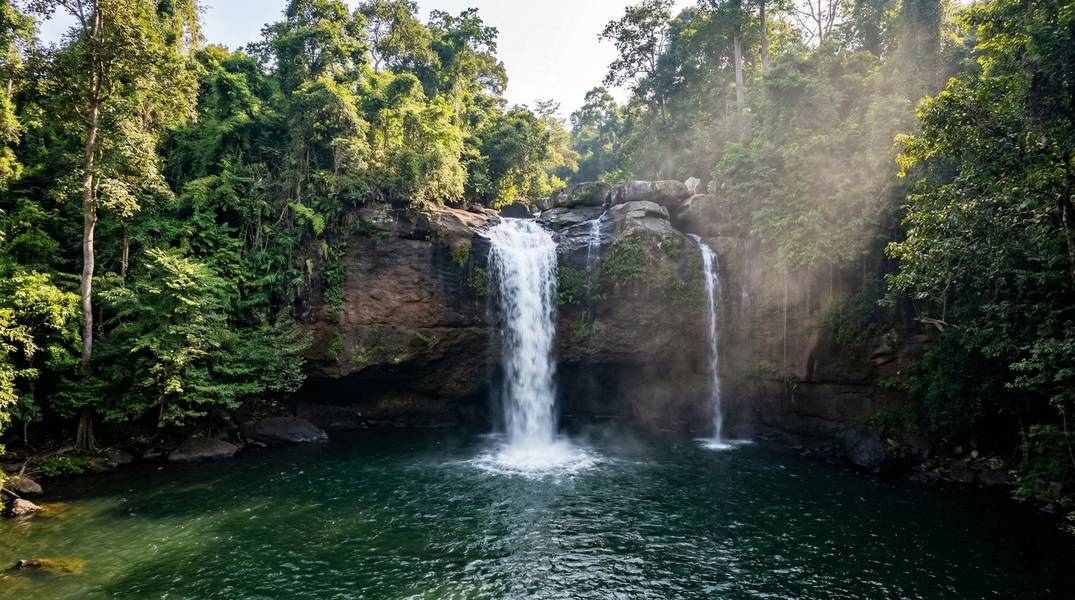
Haew Suwat Waterfall
Overview
น้ำตกเหวสุวัต • Haew Suwat Waterfall (Nam Tok Haeo Suwat)
Haew Suwat is the most visited waterfall in Khao Yai National Park — a 20-25 meter plunge waterfall where the Lam Ta Khong stream cascades over an ancient volcanic rock ledge into a deep circular pool surrounded by tropical evergreen forest. The waterfall gained international fame as the filming location for the cliff-jump scene in Leonardo DiCaprio’s “The Beach” (2000).
Located within the Dong Phayayen-Khao Yai Forest Complex — a UNESCO World Heritage Site inscribed in 2005 — Haew Suwat sits at approximately 700-750 meters elevation within Thailand’s first national park (established 1962). At just 2.5-3 hours from Bangkok, it offers medical tourists one of Thailand’s most accessible encounters with pristine tropical forest. The upper viewpoint platform requires only a short paved walk from the car park, making it suitable even for visitors with limited mobility.
Important: Park fees, hours, and trail conditions are subject to change without notice. Verify current information at the official park website before your visit. Wildlife sightings cannot be guaranteed. Weather conditions and waterfall flow vary by season.
Why Haew Suwat is Special
UNESCO World Heritage Setting
Haew Suwat lies within the Dong Phayayen-Khao Yai Forest Complex, inscribed as a UNESCO World Heritage Site in 2005. This 6,155 sq km forest complex is the second-largest in Thailand and a critical wildlife corridor across four provinces.
Key conservation significance:
- 2,168 sq km of protected forest in Khao Yai alone
- 9 endemic species found only in the Dong Phayayen-Khao Yai complex
- UNESCO-monitored management and conservation programs
- Critically endangered Siamese crocodile population in the river system
Volcanic Geology
The waterfall flows over volcanic rock substrate — remnants of volcanic activity hundreds of millions of years ago. Along the Pha Kluai Mai – Haew Suwat trail, traces of ancient lava flow are visible during the dry season. A cave exists behind the water curtain, accessible only when water levels drop sufficiently (typically December-April).
Unique Gibbon Habitat
Khao Yai is the only place in the world where White-handed (Lar) gibbons and Pileated gibbons share overlapping territory and interbreed — a key criterion in the UNESCO World Heritage inscription. Both species can be heard calling in the forest canopy around Haew Suwat during early morning hours.
Natural Features & Ecology
Landscape
Haew Suwat is a plunge waterfall where the Lam Ta Khong stream drops over a volcanic rock cliff into a deep circular pool. The surrounding forest is tropical evergreen, with dense canopy providing heavy shade along access trails. Behind the falling water curtain, a cave becomes visible during dry season months.
Flora
| Species | Notes |
|---|---|
| Dipterocarps | Dominant canopy trees throughout the forest |
| Bamboo groves | Common along the Pha Kluai Mai trail |
| Epiphytic orchids | Multiple species on cliffs near Pha Kluai Mai |
| Rattan | Understory species along trails |
| Mosses and ferns | Cover the volcanic rock face around the falls |
Fauna
The forest surrounding Haew Suwat supports a remarkable diversity of wildlife. Sightings depend on season, time of day, and luck — they are never guaranteed.
Mammals:
- Asian elephant (endangered) — occasionally cross park roads
- White-handed gibbon and Pileated gibbon (morning calls)
- Pig-tailed macaque — common along roads
- Sambar deer and barking deer (muntjac)
- Gaur (largest wild bovine)
- Asiatic black bear and Malayan sun bear
- Dhole (Asian wild dog)
- Clouded leopard (rarely seen)
- Slow loris (nocturnal)
Birds (440+ species recorded in Khao Yai):
- Great hornbill, Oriental pied hornbill, Wreathed hornbill, Austen’s brown hornbill
- Siamese fireback pheasant, Silver pheasant
- Mountain imperial pigeon
- Migratory species (October-March)
Other Water Features in Khao Yai
| Waterfall | Height | Distance from Visitor Center | Notes |
|---|---|---|---|
| Haew Suwat | 20-25m | ~10 km | Most accessible; “The Beach” filming location |
| Haew Narok | 150m (3 tiers) | ~23 km | Khao Yai’s tallest; swimming forbidden (deaths have occurred) |
| Pha Kluai Mai | ~10m | 3 km trail from Haew Suwat | Connected via nature trail |
| Kong Kaew | Small | Adjacent to Visitor Center | Easiest to reach via Trail 1 |
Activities & Experiences
Waterfall Viewing
The primary activity — viewing Haew Suwat from the upper platform or descending to the base.
| Activity | Difficulty | Duration | Post-Surgery Suitability |
|---|---|---|---|
| Viewpoint platform (upper) | Easy | 10-15 min | Week 1-2+ (paved, shaded, wheelchair accessible) |
| Descent to waterfall base | Moderate | 20-30 min | Week 3+ (120+ steep stairs; avoid post-surgery) |
| Foot dipping at base | Easy | As desired | Week 3+ (after stair descent) |
| Photography from water level | Easy | As desired | Week 3+ (after stair descent) |
Swimming is strictly prohibited. Wading and foot-dipping only at the waterfall base.
Hiking Trails
| Trail | Distance | Difficulty | Time | Guide Required | Recovery Suitability |
|---|---|---|---|---|---|
| Short Waterfall Trail (parking to viewpoint/base) | 0.6 km out-and-back | Easy-Moderate | 8-15 min (viewpoint); 20-30 min (base) | No | Viewpoint: Week 1-2+; Base: Week 3+ |
| Trail 2: Pha Kluai Mai – Haew Suwat | 3 km one-way | Easy | ~2 hours | No | Week 3+ |
| Long Trail: Visitor Center to Haew Suwat | 8 km one-way | Challenging | ~6 hours | Yes (mandatory) | Not recommended during recovery |
Short Waterfall Trail (Recommended for Medical Tourists)
The most suitable option for recovering patients.
- Distance: ~100m from parking to viewpoint platform (paved); 120+ stairs to base
- Surface: Paved path to viewpoint, then concrete steps to base
- Shade: Heavily shaded by forest canopy throughout
- Viewpoint Platform: Wheelchair accessible; benches available; top-down view of waterfall
- Base Access: 120+ steep concrete steps — not suitable for recovering patients
Trail 2: Pha Kluai Mai – Haew Suwat Nature Trail
A pleasant forest walk connecting two waterfalls.
- Distance: 3 km one-way
- Difficulty: Easy
- Elevation Gain: 60m (196 ft)
- Surface: Natural forest trail along the Lam Ta Khong stream
- Shade: Mostly shaded through bamboo and dry forest
- Highlights: Stream crossings, bamboo groves, ancient lava traces, orchids
- Start: Pha Kluai Mai Campground
- End: Haew Suwat Waterfall
Long Trail: Visitor Center to Haew Suwat (8 km)
- Guide: Mandatory ranger guide (arrange at Visitor Center)
- Start Before: 10:00 AM
- Requirements: Bring packed lunch; full hiking gear
- Start Point: Hanging bridge behind Visitor Center
- Not suitable for medical tourists recovering from any procedure
Wildlife Watching
| Species | Best Time | Best Location | Notes |
|---|---|---|---|
| Gibbons | Early morning (06:00-09:00) | Forest canopy near trails | Listen for calls |
| Hornbills | Early morning | Near Visitor Center, along trails | Daily flyovers |
| Macaques | Daytime | Along park roads | Do not feed |
| Wild elephants | Late afternoon (15:00-18:00) | Road crossings, salt licks | Stay in vehicle; do not approach |
| Sambar deer | Dusk | Grasslands | Quiet observation |
| Bat exodus | Dusk (~30 min) | Khao Luk Chang bat cave | Spectacular evening event |
Wildlife sightings depend on season, weather, time of day, and luck. Animals roam freely across 2,168 sq km of protected forest.
Photography
Best Spots:
- Viewpoint platform — top-down perspective of the full waterfall
- Waterfall base (after stair descent) — dramatic low-angle shots
- Km 30 Viewpoint — sunrise and morning mist (separate location within park)
- Khao Luk Chang bat cave — dusk bat exodus
Sunrise/Sunset: Approximately 06:00 / 18:00 (varies by season). Km 30 viewpoint is the park’s premier sunrise location.
Camping
Two campsites within Khao Yai National Park:
| Campsite | Location | Tent Rental |
|---|---|---|
| Lam Ta Khong | Near Visitor Center (largest) | 2-person: 150 THB; 3-4 person: 225 THB |
| Pha Kluai Mai | Near Pha Kluai Mai Waterfall | Same rates |
Sleeping bags, mats, pillows, blankets: 20-50 THB each. Tents rented on-site (no advance booking). Bungalows and lodges must be booked via DNP website up to 60 days in advance.
Other Activities in Khao Yai
- Night safari — Vehicle-based evening wildlife watching (ideal for recovery patients)
- Scenic driving — 50 km paved Thanarat Road through the park
- Birdwatching — 440+ species recorded
- Bat cave viewing — Khao Luk Chang at dusk
For Medical Tourists
Physical Requirements Assessment
| Factor | Level | Details |
|---|---|---|
| Walking Distance | Minimal to moderate | 100m to viewpoint (paved); 120+ stairs to base |
| Elevation | ~700-750m | Cooler than Bangkok; no altitude concerns |
| Temperature | 21°C average | Can drop below 10°C in December-January |
| Shade | Excellent | Heavy forest canopy covers trail and viewpoint |
| Rest Areas | Good | Benches at viewpoint; restaurant and cafe at parking area |
| Mobile Signal | Limited | Some signal at parking area; limited to none on trails |
Recovery Week Recommendations
| Activity | Difficulty | Earliest Safe | Ideal Week | Key Considerations |
|---|---|---|---|---|
| Viewpoint platform only | Easy | Week 1 | Week 1-2+ | Paved, shaded, wheelchair accessible; no stairs |
| Restaurant and cafe area | Easy | Week 1 | Week 1+ | Facilities at parking area with nature views |
| Descent to waterfall base | Moderate | Week 3 | Week 3+ | 120+ steep stairs — fall hazard |
| Pha Kluai Mai trail (3 km) | Easy | Week 3 | Week 3+ | Natural terrain; 2-hour walk |
| Scenic driving through park | Easy | Week 1 | Week 1+ | No walking required; air-conditioned vehicle |
Procedure-Specific Guidance
| Procedure Type | Earliest Visit | Recommended Activities |
|---|---|---|
| Dental (simple) | Week 1 | Viewpoint, scenic driving |
| Dental implant | Week 1-2 | Viewpoint, scenic driving |
| LASIK | Week 2 | All viewpoint activities; bring UV sunglasses |
| Minor cosmetic | Week 1-2 | Viewpoint, scenic driving, restaurant |
| Rhinoplasty | Week 2 | Viewpoint only; avoid stair descent |
| Abdominal surgery | Week 3 | Viewpoint only; avoid stairs and trails |
| Orthopedic (minor) | Week 3 | Viewpoint only; avoid stairs and uneven terrain |
| Cardiac procedures | Week 4+ | Consult cardiologist; viewpoint only if approved |
| Hip/knee replacement | Week 6+ | Doctor approval required; viewpoint only |
Medical Advisory: Consult your treating physician before outdoor activities post-surgery. Haew Suwat is located inside Khao Yai National Park — the nearest hospital is 25-40 minutes away by car. The 2.5-3 hour drive from Bangkok may be uncomfortable for patients recovering from major procedures. Early morning visits (06:00-09:00) avoid midday heat.
Who Should Visit
- Patients seeking a gentle nature experience during recovery (viewpoint only)
- Those who can tolerate a 2.5-3 hour car journey from Bangkok
- Visitors who want cooler temperatures (21°C average vs. Bangkok’s 30°C+)
- Photography enthusiasts (viewpoint is accessible without stairs)
Who Should NOT Visit
- Patients within 1 week of major surgery (long car journey)
- Anyone unable to tolerate a 2.5-3 hour car ride each way
- Cardiac patients without explicit doctor approval
- Patients who require immediate access to medical facilities
Nearest Hospitals
| Hospital | Type | Distance from Park Entrance | Travel Time | Key Services |
|---|---|---|---|---|
| Bangkok Hospital Khao Yai | Private (BDMS) | ~25 km | 30-40 min | International standard, multilingual staff, helicopter transfer |
| Bangkok Hospital Pak Chong | Private (BDMS) | ~20 km | 25-35 min | Multi-disciplinary specialists, advanced life support ambulances |
| Pakchong Hospital | Government | ~20 km | 25-35 min | Public hospital, emergency department |
| Maharat Nakhon Ratchasima | Regional government | ~130 km | 1.5-2 hours | Major regional hospital for serious cases |
Emergency Contacts:
- National Emergency Medical Service: 1669
- Tourist Police: 1155
- Police: 191
- Park ranger station (inside park)
Getting There
From Bangkok by Car (Recommended)
| Detail | Information |
|---|---|
| Distance | ~185 km to park; ~24 km from park entrance to Haew Suwat |
| Duration | 2.5-3 hours to park entrance |
| Route | Highway 1 → Highway 2 (Mittraphap Road) to Pak Chong; OR Motorway No. 6 (Bang Pa-in – Nakhon Ratchasima) |
A private vehicle is essential — there is no public transport inside the park. The 24 km park road from the Pak Chong entrance to Haew Suwat is paved but has steep and winding sections. No night driving is permitted.
From Bangkok by Public Transport
Step 1: Bangkok to Pak Chong
| Option | Departure | Duration | Cost |
|---|---|---|---|
| Minivan | Mo Chit Bus Station | 2.5-3 hours | 160-180 THB |
| Bus | Mo Chit (every 30 min) | 3.5-4 hours | ~180 THB |
| Train | Hua Lamphong | 4-5 hours | Varies (trains every 3 hours, 05:45-22:25) |
Step 2: Pak Chong to Park Entrance
| Option | Details | Cost |
|---|---|---|
| Local bus | Every 30 min, 06:00-17:00 | 15 THB |
| Private taxi | From Pak Chong town | 200-300 THB |
Step 3: Park Entrance to Haew Suwat (~24 km)
No public transport operates inside the park. Options:
- Own vehicle or rental car (most practical)
- Scooter rental at park entrance gate (~600 THB/day)
- Hitchhiking (common but unreliable)
- Private tour with transport included (recommended for visitors without vehicles)
By Taxi from Bangkok
Day trip by Bangkok taxi: approximately 4,000 THB including fuel. Negotiate fare and waiting time before departure.
Vehicle Restrictions
Vehicles with more than 6 wheels, double-decker vehicles, vehicles taller than 3.50m, and towed RVs are forbidden from entering the park.
Parking
Large car park at Haew Suwat with restaurant, cafe, convenience store, and restrooms.
Accommodation
Inside Khao Yai National Park
Bungalows (Book via DNP website, up to 60 days in advance):
| Type | Capacity | Price |
|---|---|---|
| Fan rooms (Zone 3 Suratsawadee) | 2 people | 800 THB/night |
| Lodges | 6-28 people | 2,000-9,000 THB/night |
- Payment: Within 2 days via 7-Eleven or bank transfer
- International visitors: Transfer to Krung Thai Bank + email np_income@dnp.go.th
- Discount: 30% off Monday-Thursday
- Note: International visitors may have difficulty with the Thai payment process
Camping: Tents available on-site at Lam Ta Khong and Pha Kluai Mai campsites (see Camping section above).
Outside the Park
Advantages for medical tourists:
- Closer to hospitals and medical facilities
- More accommodation choices (budget to luxury)
- More restaurant options
- Easier booking process
Areas:
- Pak Chong town (~30 km from park gate) — Budget guesthouses to mid-range hotels
- Khao Yai area (outside park) — Boutique resorts, luxury hotels (InterContinental Khao Yai, Botanica Khao Yai)
- Wang Nam Khiao — Eco-resorts
Booking Tips:
- Book 3 months ahead for Thai holidays (New Year, Songkran, long weekends)
- Weekdays: walk-in often possible at park accommodation
- Peak season (December-January): all options fill quickly
Practical Tips
What to Bring
Essential:
- Comfortable walking shoes with good grip (steps can be slippery)
- Water (minimum 1L)
- Sun protection: hat, sunscreen, sunglasses
- Insect repellent (DEET-based recommended)
- Rain jacket (year-round; afternoon storms common)
- Cash (THB) for entry fees, food, parking
- Offline maps downloaded before entering park
- Hospital contact card with emergency numbers
Rainy Season Additions (June-October):
- Leech socks (available at Visitor Center or in Pak Chong)
- Waterproof bag for electronics
- Change of clothes
- Quick-dry towel
For Recovery Patients:
- Prescribed medications
- Cooling towel or portable fan
- Comfortable seat cushion for the car journey
- Light snacks and electrolyte drinks
- Mobile phone fully charged (limited charging options inside park)
What NOT to Bring
The following items are prohibited inside Khao Yai National Park:
- Single-use plastic bags (under 36 microns)
- Plastic food containers, cups, straws, cutlery
- Foam/styrofoam containers
- Alcohol
- Pets
- Loud music or speakers
Penalties: Littering fines up to 500,000 THB and/or up to 5 years imprisonment. Plastic ban violation fines up to 100,000 THB. Khao Yai famously mails trash back to litterers’ home addresses.
Safety Considerations
Trail Safety:
- The 120+ stairs to the waterfall base are steep and can be slippery, especially after rain
- Use handrails where available
- Wear shoes with good grip — not sandals or flip-flops
- Take stairs slowly; rest on landings if needed
Wildlife Safety:
- Leeches: Common June-October on jungle trails. Wear leech socks, apply DEET repellent, wear long pants
- Wild elephants: Occasionally cross roads. Stay in vehicle, do not approach, do not block their path
- Macaques: Can be aggressive near food. Do not feed any wildlife
- Snakes: King cobras and pit vipers present but encounters are rare. Wear covered shoes, stay on trails
- Mosquitoes: Dengue fever risk. Use repellent. Long sleeves and pants recommended
Water Safety:
- Swimming is strictly prohibited at Haew Suwat Waterfall
- Siamese crocodile population confirmed in the park’s river system
- Strong currents during rainy season
- Do not enter water beyond foot-dipping at the base
- Post-surgery patients with open or healing incisions should avoid contact with natural water sources due to infection risk
Heat and Weather:
- Flash floods possible during monsoon season (June-October)
- Lightning risk during afternoon storms
- Early morning visits (06:00-09:00) avoid midday heat
- Temperatures can drop below 10°C in December-January — bring layers
Communication:
- Mobile signal limited to none inside park interior
- Some signal near main road and parking areas
- Download offline maps before entering
- Inform someone of your plans and expected return time
Environmental Responsibility
Park Rules
Khao Yai is a protected UNESCO World Heritage Site with strict enforcement:
- No feeding wildlife — Disrupts natural behavior and is dangerous
- No collecting — Plants, animals, rocks, and soil must remain in the park
- No littering — Carry out all trash; Khao Yai has mailed trash back to offenders since 2020
- No loud music — Disturbs wildlife and other visitors
- Stay on marked trails — Protects vegetation and your safety
- No flash photography of nocturnal animals
- No night driving — Protects nocturnal wildlife
- No swimming at Haew Suwat — Protects aquatic ecosystem
Ethical Wildlife Guidelines
- Maintain safe distance from all wildlife — never approach
- Stay in your vehicle on roads when elephants or other large animals are present
- Do not feed macaques, deer, or any animals
- Report injured wildlife to park rangers
- Use binoculars for closer views rather than approaching
Conservation Programs
- UNESCO World Heritage monitoring and management
- Dong Phayayen-Khao Yai Forest Complex conservation corridor
- Wildlife passage under motorway (connecting Khao Yai to Thap Lan for potential tiger recolonization)
- Elephant monitoring program
- Hornbill conservation program
Seasonal Guide
Month-by-Month Conditions
| Month | Weather | Temperature | Waterfall Flow | Medical Tourist Rating |
|---|---|---|---|---|
| January | Cool, dry, sunny | 10-25°C | Low-moderate | Excellent |
| February | Cool, dry | 15-28°C | Low | Excellent |
| March | Warming, hazy | 20-30°C | Low (dry season minimum) | Good |
| April | Hot season peak | 25-35°C | Minimum flow | Fair (heat caution) |
| May | Rain begins | 22-30°C | Increasing | Fair |
| June | Rainy; some trails may close | 22-28°C | Strong | Not recommended (leeches, mud) |
| July | Peak rainfall | 22-27°C | Very strong | Not recommended |
| August | Heavy rain continues | 22-27°C | Near peak; magnificent flow | Not recommended |
| September | Rain continues | 22-27°C | At or near peak | Not recommended |
| October | Rain easing | 21-28°C | Spectacular flow | Good (late month) |
| November | Cool season begins | 15-25°C | Good flow from recent rains | Excellent |
| December | Coolest month | 10-25°C (below 10°C at night) | Moderate | Excellent (book ahead) |
Best Months by Activity
| Activity | Best Months | Notes |
|---|---|---|
| Waterfall photography | Sep-Nov | Maximum water volume with improving weather |
| Comfortable viewing | Nov-Feb | Cool, dry, pleasant; moderate flow |
| Wildlife watching | Nov-Feb | Animals more active in cool weather |
| Birdwatching | Nov-Mar | Resident species plus migratory birds |
| Avoiding crowds | Jun-Sep | Fewest tourists (but rainy/muddy conditions) |
| Overall best visit | Oct-Nov | Strong waterfall flow + cool season beginning |
Seasonal Warnings
Rainy Season (June-October):
- Trails muddy and slippery; stairs to waterfall base hazardous
- Leeches very active (especially on jungle trails)
- Some viewpoints and trails closed for safety
- Flash flood risk near waterfall
- Fewer tourists; park less crowded
Hot Season (March-May):
- Waterfall at minimum flow (least impressive)
- Midday temperatures uncomfortable (up to 35°C)
- Visit early morning only; stay hydrated
- Higher risk of heat exhaustion for recovery patients
Cool Season (November-February):
- Best overall conditions for medical tourists
- Nights can be cold (below 10°C in December-January) — bring warm layers
- Peak tourist season — weekends and holidays very crowded
- Book accommodation well in advance
Wildlife Calendar
- Year-round: Gibbons (morning calls), macaques, hornbills
- October-March: Migratory bird species (raptors, warblers)
- Year-round: Wild fig fruiting attracts hornbills and gibbons
- Cool season: Orchids and wildflowers peak
Nearby Attractions
Within Khao Yai National Park
| Attraction | Distance from Haew Suwat | Notes |
|---|---|---|
| Pha Kluai Mai Waterfall | 3 km trail | Connected via nature trail |
| Haew Narok Waterfall | ~23 km from Visitor Center | Khao Yai’s tallest (150m); swimming forbidden |
| Kong Kaew Waterfall | Near Visitor Center | Easiest waterfall to reach |
| Km 30 Viewpoint | Along park road | Sunrise and morning mist |
| Khao Luk Chang Bat Cave | Along park road | Spectacular dusk bat exodus (~30 min) |
| Sai Sorn Reservoir | Near park road | 2 km circular trail |
Outside the Park
| Attraction | Description |
|---|---|
| PB Valley Khao Yai Winery | Thai wine tasting and vineyard tours |
| GranMonte Vineyard and Winery | Boutique winery with restaurant |
| Palio Khao Yai | Italian-themed village and market |
| Primo Piazza | Mediterranean-themed photo spot |
| Chao Por Khao Yai Shrine | At park entrance |
| Pak Chong fresh market | Local produce and street food |
Combining with Other Destinations
Haew Suwat pairs well with a broader Khao Yai National Park visit:
- Half-day: Haew Suwat viewpoint + scenic drive + restaurant lunch
- Full day: Haew Suwat + Haew Narok Waterfall + Km 30 Viewpoint
- Overnight: Add night safari, bat cave viewing, and early morning birdwatching
Useful Thai Phrases
| English | Thai | Pronunciation |
|---|---|---|
| Hello | สวัสดี | Sa-wat-dee |
| Thank you | ขอบคุณ | Khob khun |
| How much? | เท่าไหร่? | Thao rai? |
| Waterfall | น้ำตก | Nam tok |
| National park | อุทยานแห่งชาติ | Ut-tha-yan haeng chat |
| Help! | ช่วยด้วย! | Chuay duay! |
| Hospital | โรงพยาบาล | Rong pha-ya-ban |
| Where is…? | …อยู่ที่ไหน? | …yoo tee nai? |
Entry Fees
| Visitor Type | Fee |
|---|---|
| Foreign adult | 400 THB (~$11 USD) |
| Foreign child (under 14) | 200 THB |
| Thai adult (with ID) | 40 THB |
| Thai child | 20 THB |
| Car | 50 THB |
| Motorcycle | 30 THB |
- Khao Yai is classified Category 2 under DNP pricing
- Fee covers same-day entry; multi-day tickets available for overnight guests (valid 3 days)
- Pay at park entrance gates — cash only
- Thai resident rates require Thai passport or Thai ID only
Prices subject to change without notice. Verify current fees at the official park website or entrance gates.
Safety Summary
- Swimming: Strictly prohibited at Haew Suwat — enforced by rangers
- Stairs: 120+ steep steps to waterfall base — use caution; not suitable post-surgery
- Wildlife: Maintain safe distance; never feed or approach animals
- Leeches: Common June-October; wear leech socks and DEET repellent
- Weather: Be prepared for sudden rain; avoid trails during heavy downpours
- Heat: Visit early morning; stay hydrated; rest frequently
- Communication: Limited mobile signal — download offline maps; inform someone of your plans
- Medical: Nearest hospitals 25-40 minutes from park entrance; carry emergency contacts
- Driving: No night driving permitted inside the park
Disclaimer: Outdoor activities involve inherent risks. Weather conditions, trail conditions, and wildlife behavior are unpredictable and may change without notice. Medical tourists should consult their treating physician before visiting. Park fees, hours, regulations, and trail access may change without notice. Nature experiences are described for wellbeing and enrichment — not as medical treatments.
Frequently Asked Questions
Is Haew Suwat Waterfall suitable for medical tourists recovering from procedures?
Yes, with activity selection. The paved path from the car park to the upper viewpoint platform is short (approximately 100 meters), shaded, and wheelchair accessible — suitable from recovery week 1-2 for dental or minor cosmetic patients. The descent to the waterfall base via 120+ steep steps is NOT suitable during recovery. The park's cooler temperatures (average 21°C) provide welcome relief from Bangkok's heat. Consult your doctor before any outdoor activities post-surgery.
Can I swim at Haew Suwat Waterfall?
No. Swimming is strictly prohibited at Haew Suwat Waterfall and actively enforced by park rangers. Reasons include strong water force (especially during rainy season), Siamese crocodile presence in the river system, historical injuries from cliff jumping, and conservation of the aquatic ecosystem. Visitors may wade and dip their feet only at the waterfall base. Post-surgery patients with open or healing incisions should avoid contact with natural water sources due to infection risk.
Is this the waterfall from the movie "The Beach"?
Yes. The cliff-jump scene in 'The Beach' (2000), directed by Danny Boyle and starring Leonardo DiCaprio, was filmed at Haew Suwat Waterfall. The character jumps over the cliff into the pool below. Note: jumping and swimming are now strictly prohibited at the waterfall.
How do I get to Haew Suwat from Bangkok?
Drive 2.5-3 hours via Highway 1 → Highway 2 (Mittraphap Road) to Pak Chong, then enter Khao Yai National Park. Haew Suwat is approximately 24 km from the Pak Chong entrance gate (~10 km east of the Visitor Center). There is no public transport inside the park — own vehicle, rental car, or private tour is required.
Is there mobile phone signal at the waterfall?
Mobile signal is limited to none at Haew Suwat Waterfall. Some signal may be available near the parking area and along the main park road. Download offline maps before entering the park and inform someone of your plans.
What are the park entry fees?
Foreign adults: 400 THB (~$11 USD). Foreign children (under 14): 200 THB. Thai adults with ID: 40 THB. Thai children: 20 THB. Vehicle fee: 50 THB (cars), 30 THB (motorcycles). Khao Yai is classified Category 2 under DNP pricing. Fees subject to change without notice.
Can I visit during rainy season?
Yes, the park is open year-round, though specific trails and viewpoints may close June-September due to hazardous conditions. Rainy season (June-October) brings the most spectacular waterfall flow but trails are muddy and slippery, and leeches are active. The short paved trail to the viewpoint remains accessible. Late rainy season (September-October) offers the best combination of water volume and improving weather.
Is there a cave behind the waterfall?
Yes, a cave exists behind the water curtain that becomes visible and potentially accessible during the dry season (December-April) when water levels drop. Accessibility varies by year and conditions — check with park rangers on-site for current status.
Do I need a guide?
No guide is needed for the short trail from the parking area to Haew Suwat viewpoint and base. The 3 km Pha Kluai Mai – Haew Suwat nature trail also does not require a guide. The 8 km long trail from the Visitor Center requires a mandatory guide — arrange at the Visitor Center before 10:00 AM.
Need Help Planning Your Visit?
Our team can help coordinate your visit to Haew Suwat Waterfall during your stay in Thailand.
Check your insurance coverage before booking your medical trip.