
Koh Kood
Overview
เกาะกูด • Koh Kood (Ko Kut, RTGS)
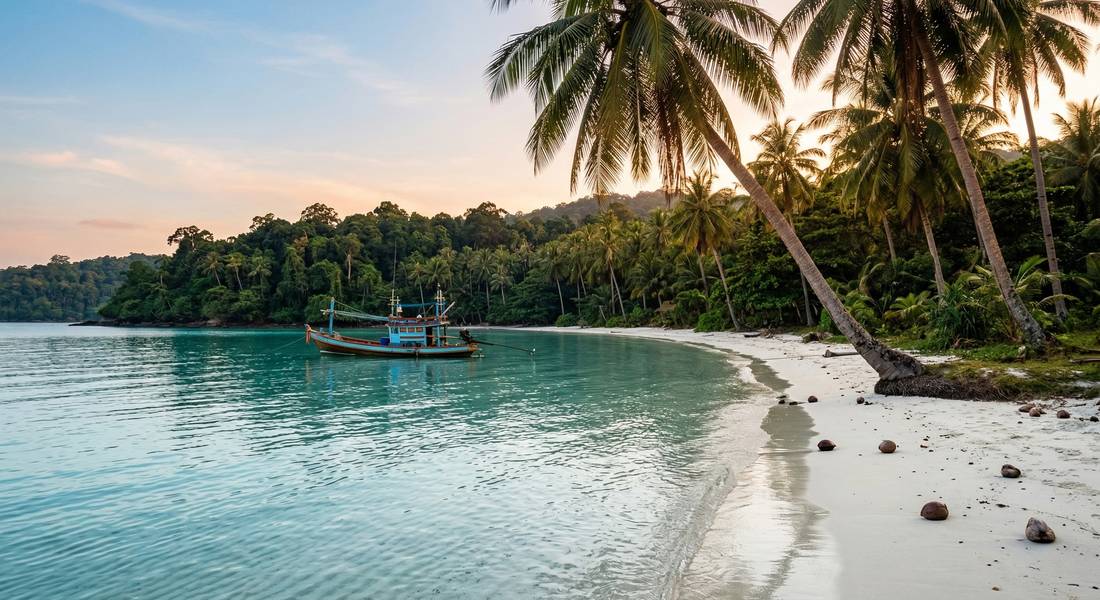
Koh Kood is Thailand’s fourth-largest island at approximately 105 sq km (25 km long by 12 km wide), yet it remains the country’s most pristine major island destination. Located in the southernmost reaches of the Koh Chang archipelago in Trat Province, near the Cambodian border, this jungle-clad island is home to just ~2,000 permanent residents — making it the least populated district in Thailand. The Tourism Authority of Thailand describes it as “an unspoiled slice of tropical heaven.”
What sets Koh Kood apart from other Thai islands is what it lacks: there is no nightlife, no overdeveloped coastline, no party scene. Instead, the island offers powdery white-sand beaches along the western coast, dense tropical rainforest in the interior, ancient trees estimated at 200-500 years old, crystal-clear waters with vibrant coral reefs, and authentic Thai-Cambodian fishing villages that still operate as they have for generations. The development level has been compared to 1990s-era Koh Samui.
With 51 accommodation properties and 1,360 rooms, Koh Kood serves couples, families, and nature seekers drawn to its tranquility. The economy blends traditional fishing, rubber tapping, coconut farming, and growing eco-tourism. Recent statistics show 21.89% year-over-year tourism growth, with top international visitors from Germany, Russia, France, UK, Finland, Australia, and Switzerland.
For medical tourists, Koh Kood offers an exceptionally peaceful late-stage recovery environment with gentle beach activities, calm warm waters, and a stress-free atmosphere. However, the island’s remoteness means limited medical facilities — only a basic government hospital with no surgical capability. The nearest full hospital (Bangkok Hospital Trat) is 1+ hour by ferry. This makes Koh Kood suitable only for those well past the critical recovery period who are unlikely to need emergency medical attention.
Ferry schedules, accommodation rates, and activity prices are subject to change. Weather and sea conditions may vary significantly from seasonal norms. Verify current information with operators before booking.
History & Significance
Island Heritage
- Royal visit: King Rama VI named the main waterfall “Anamkok” in 1911, commemorating Ong Chiang Lue, a Vietnamese King who took refuge in Siam during King Rama I’s reign
- Ancient trees: Two Makka trees estimated at 200-500 years old — locals leave offerings believing spirits inhabit old trees
- Traditional economy: Fishing, rubber tapping, coconut farming, and fruit cultivation
- Fishing heritage: Ao Salad and Ao Yai fishing villages maintain authentic Thai-Cambodian fishing culture
- Cultural artifacts: Chonthicha Seafood restaurant in Ao Yai displays ancient Chinese ceramics caught by fishermen from sunken Chinese junks
Island Character
Koh Kood sits in the Gulf of Thailand approximately 315-330 km from Bangkok, 45 km from Laem Sok Pier on the mainland. It is the second-largest island in Trat Province after Koh Chang. The island’s character is defined by its remoteness and minimal development — a mixture of Thai and Cambodian fishing communities, rubber plantations, coconut groves, and a growing but carefully managed tourism sector.
Island Character & Ecology
Landscape
Jungle-clad hills dominate the interior, with pristine white-sand beaches concentrated along the west coast. The east coast is rocky and largely undeveloped. Dense mangrove estuaries, rubber plantations, coconut groves, and multiple inland brooks and streams shape the landscape. The climate is tropical monsoon (Köppen-Geiger classification).
Flora
- Ancient Makka trees: Two stunning specimens estimated at 200-500 years old — “Sai Yai” and “Mayayuk” — located near Khlong Hin Dam Village
- Dense mangrove forests along river estuaries
- Coconut palm groves lining coastal areas
- Rubber tree plantations in the interior
- Tropical rainforest canopy covering the hills
Fauna
Terrestrial:
- Monkeys (spotted at Ao Yai viewpoint)
- Various bird species in mangroves and forest
- Fireflies (visible in mangroves at dusk — best seen by kayak)
Marine Fish:
- Yellowtail barracuda (large schools), snapper, fusiliers (huge schools)
- Parrotfish (including humphead), groupers, sweetlips (including juvenile harlequin)
- Angelfish, scorpionfish, lionfish, pufferfish, batfish
- Titan triggerfish, clownfish (including panda clownfish), bannerfish
- Cobias, rainbow runner, Indian Ocean Walkmen
Other Marine Life:
- Blue-spotted stingrays, cuttlefish, octopus, squid
- Nudibranchs (many species), giant clams, moray eels, colorful shrimp
Rare Sightings:
- Sea turtles (occasional), seahorses
- Razorfish (vertically swimming — very rare)
- Flounder, giant sea stars (rare)
Marine wildlife is wild and unpredictable. Sightings of turtles, seahorses, and other species are never guaranteed. The best conditions for wildlife encounters depend on season, weather, and location.
Coral Reefs
Coral reefs are found between 6 and 21 meters depth along the coast, featuring hard coral formations, giant barrel sponges, whip corals, staghorn corals, and huge table corals (particularly at Koh Raet). Sea fans are rare around Koh Kood — found primarily at the Neverland dive site.
Conservation efforts:
- Approximately 5 PVC-based coral nurseries placed around Koh Kood, facilitating reef regeneration
- Underwater sculpture park at Koh Raet (elephant, tiger, horse, cow, dog shapes) serving as coral nurseries
- Mu Ko Rang National Marine Park (15 km northwest) — strictly protected marine sanctuary with no fishing
Waterfalls
Klong Chao Waterfall (Nam Tok Klong Chao) — royal name “Anamkok” (named by King Rama VI, 1911):
- ~10m drop into a large natural pool ideal for swimming
- Jumping from top at two heights: approximately 3m and 6m
- Access: 600m walk from road through rainforest, or kayak up Klong Chao river
- Free entry. Main freshwater resource on the island and most popular attraction
Klong Yai Kee Waterfall:
- Smaller and more secluded than Klong Chao
- River reaches sea at Yai Ki bay forming a beautiful mangrove estuary
- Located in the northwest of the island
Huang Nam Keaw Waterfall (formerly “Secret Waterfall”):
- Deep interior jungle waterfall reached by trek through remote rainforest
- Main charm is the jungle setting beyond the ancient Makka trees
- Located in center-east of island — requires trek through jungle
Mangrove Estuaries
- Klong Chao river estuary — kayakable from beach to waterfall
- Ao Tapao Mangrove Bay — hidden gem for kayaking at low tide
- Klong Yai Ki estuary — river meets sea forming dramatic mangrove habitat
Beaches
All notable beaches are on the west coast. The east coast is rocky and undeveloped.
Primary Beaches
| Beach | Location | Character | Best For |
|---|---|---|---|
| Klong Chao | Central west | Crown jewel — soft powdery sand, gentle waves, island’s social hub | First-time visitors, convenience, families |
| Ao Tapao | North/northwest | Most accessible — long golden sands, palm-lined, water sports | Water sports, families, those wanting services nearby |
| Bang Bao | Mid west | Gorgeous horseshoe bay, near-perfect lagoon feel, sheltered | Relaxation, couples, solitude seekers |
| Ao Prao (Ao Phrao) | Southwest | Long lush beach, upscale resorts, spectacular sunsets | Peace seekers, romantics, sunset lovers |
| Ao Noi | West | Dramatic cliff-enclosed seclusion, hidden alcove at low tide | Complete seclusion seekers |
| Kluai (Ao Kluai) | West | Undiscovered powdery white-golden sand, turquoise waters | Off-the-beaten-path beach lovers |
| Ao Jak (Neverland Beach) | Southwest | Remote, accessed via winding road through coconut fields | Remote beach explorers |
Note: Beach quality at Ao Jak varies — some visitors report debris on shore.
Additional Beaches
- Ao Takian — southwest, beautiful and remote
- Ao Klong Hin — southwest, beautiful and remote
- White Beach / Hat Sai Khao — west, expansive white sand
Beach Safety
Box jellyfish stings have been reported at Bang Bao Beach. Swim with caution and check for posted warnings. See the Safety & Precautions section for detailed jellyfish safety information.
Activities & Experiences
Snorkeling
Crystal-clear waters, shallow coral reefs, and mild currents make Koh Kood suitable for all skill levels.
Cost: ~1,000 THB per person (includes hotel transfers, boat, equipment, lunch, drinks). Koh Rang trip: ~1,200 THB plus 200 THB national park entry. Prices are approximate and subject to change.
Top Snorkeling Sites
| Site | Highlights | Post-Surgery Suitable |
|---|---|---|
| Bang Bao Reef | Calm waters, seahorse sightings possible | ✅ Week 3+ (gentle, calm) |
| Hin Ao Salad | Bannerfish, anemone fish, rare giant sea stars | ✅ Week 3+ |
| Ao Yai Koet | Panda clownfish, sweetlips, flounders, scorpionfish | ✅ Week 3+ |
| Ao Kluai | Barracuda, fusiliers, turtles, seahorses | ✅ Week 3+ |
| Hin Ao Yai | Stingrays, scorpionfish, groupers | ✅ Week 3+ |
| Koh Raet | Underwater sculpture park, dense reef, huge table corals | ✅ Week 3+ |
| Koh Rang Marine Park | Healthiest coral in region, crystal-clear waters (200 THB entry) | ⚠️ Week 3+ (longer boat ride) |
Snorkeling Advisory: Always consult your doctor before snorkeling post-procedure. Even gentle snorkeling involves physical exertion, sun exposure, and saltwater contact. Wear reef-safe sunscreen and a rashguard. Never touch coral or marine life.
Diving
About 10 dive sites are located close to the island (5-20 minutes by boat) with minimal currents suitable for beginners. Best visibility is December to February. Water temperature is 27-31°C year-round. East coast sites remain available during monsoon season.
Day trip cost: ~3,000 THB per person (subject to change). PADI certification courses available.
Operators: BB Divers, Koh Kood Divers, Paradise Divers
Dive Sites
| Site | Depth | Highlights |
|---|---|---|
| Koh Raet (Koh Rat) | 4-15m | Underwater sculpture park, huge table corals, blue-spotted stingrays, humphead parrotfish. North end for beginners (4-8m). |
| Ao Toom (Ao Tum) | 5-14m | Two reefs separated by sand strip. Giant clams, yellowtail barracuda, moray eels, turtles. Some of Koh Kood’s finest coral. |
| Neverland | Variable | Large rock and hard coral formations, rare sea fans, yellowtail barracuda, Indian Ocean Walkmen |
| Hin Chedi (House Reef) | Variable | Huge reef with shore entry possible. Nudibranchs, lionfish, stingrays. Perfect for beginners. |
| Hin Yedhi | Variable | Parrotfish, jackfish, lionfish, nudibranchs |
| Ao Sonewa | Variable | Beautiful hard coral reefs, excellent for freediving |
| Bang Bao Reef | Variable | Calm waters, seahorses possible |
Nearby: Koh Rang National Marine Park (40 min by speedboat) — protected marine sanctuary with pristine reefs. HTMS Chang Wreck near Koh Chang — Thailand’s largest shipwreck at 110m length.
Diving Medical Advisory: Scuba diving is NOT recommended during any post-surgery recovery period. Diving carries risks including decompression sickness, barotrauma, and physical exertion that can compromise healing. Pressure changes are contraindicated for recent cardiac, orthopedic, and dental procedures. Do not fly within 18-24 hours of your last dive. Always complete diving medical questionnaires honestly and consult a dive physician if you have any health conditions.
Kayaking
Excellent kayaking conditions with mangrove estuaries, river routes, and coastal paddling. Many resorts provide free kayaks — ask before renting elsewhere.
Kayaking Routes
| Route | Description | Post-Surgery Suitable |
|---|---|---|
| Klong Chao River | Enter estuary from beach, paddle upriver through mangroves to waterfall (~1.5 km). Halfway back, take small left branch into stunning quiet mangrove area. | ✅ Week 3+ (calm, flat water) |
| Ao Tapao Mangrove | Hidden gem — mangrove-fringed inlet great for kayaking at low tide. Tangled roots, dramatic bird life. | ✅ Week 3+ |
| Klong Yai Ki Estuary | River reaches sea forming beautiful mangrove estuary | ✅ Week 3+ |
| Coastal Paddling | Paddle along beaches, explore nearby coves, watch sunset from sea | ⚠️ Week 3+ (check conditions) |
Tips:
- Kayak recommended over SUP for river and mangrove routes (shallow water, rocks near waterfall)
- Dusk kayaking in mangroves offers firefly spotting
- Consult your doctor before kayaking post-procedure — upper body exertion varies by route
Fishing Village Visits
Ao Salad Fishing Village
| Detail | Information |
|---|---|
| Location | Northeast coast (main ferry arrival port) |
| Highlights | ~20m seated golden Buddha at temple, viewpoint tower, wooden walkway with stilted houses, fish net making, colorful boats |
| Dining | Ao Salad Seafood (budget, near pier), Captain Nhong Seafood (recommended for food and views) |
| Activities | Dutchman Fishing Tours — full-day and overnight fishing |
| Visit Duration | 20-30 minutes to wander |
| Post-Surgery | ✅ Suitable from Week 2+ (flat walkway, gentle stroll) |
Ao Yai Fishing Village
| Detail | Information |
|---|---|
| Location | Southeast coast |
| Access | By scooter — road is hilly with sharp curves. Avoid after dark (no road lighting). |
| Highlights | Ao Yai Viewpoint with sweeping panorama (monkeys sometimes spotted), stilted houses over water connected by boardwalks, brightly painted fishing boats, wooden lobster pot towers, nets of drying fish. Very photogenic. |
| Dining | Noochy Seafood — possibly Koh Kood’s most famous restaurant, built on stilts over water with incredibly fresh seafood. Chonthicha Seafood — collection of ancient Chinese ceramics, good fish and crab. |
| Tips | Arrive early for meals — best food goes early. Aim for noon (not 2pm) and 6:30pm (not 8pm). |
| Post-Surgery | ⚠️ Week 3+ (hilly scooter ride required) |
Waterfall Swimming
Klong Chao Waterfall: Large natural pool beneath waterfall for swimming. Jump from top at 3m and 6m heights. Access via 600m walk through rainforest or kayak up river. Free entry.
Huang Nam Keaw Waterfall: Remote jungle waterfall swimming reached by trek through dense forest.
Waterfall Advisory: Waterfall treks involve uneven terrain and moderate physical exertion. The 600m walk to Klong Chao Waterfall is through rainforest on an unpaved trail. Jumping from the waterfall carries serious risks including spinal injury and drowning, with no medical supervision available on site. Jumping is absolutely contraindicated for all post-surgery patients regardless of procedure type or recovery timeline. Consult your doctor before any strenuous outdoor activity.
Other Activities
- Yoga classes at select resorts
- Nature hikes to ancient Makka trees (moderate, uneven trail)
- Island-hopping boat trips to nearby islands
- Sunset watching (especially from Ao Prao Beach)
- Photography tours of fishing villages
- Spa treatments at luxury resorts
- Trekking through rainforest interior
For Medical Tourists
Physical Requirements Assessment
| Factor | Level | Details |
|---|---|---|
| Ferry Transfer | Moderate | 1.5-2 hours from Laem Sok Pier; speedboat 40-75 min. Calm in dry season. |
| Beach Relaxation | Easy | Multiple flat, accessible west coast beaches with calm waters |
| Gentle Swimming | Easy | Warm, calm waters (27-31°C) in sheltered bays |
| Kayaking (Mangroves) | Easy-Moderate | Calm flat water in estuaries; upper body effort |
| Snorkeling (Boat Tour) | Moderate | Requires boarding boats; sun exposure |
| Waterfall Trek | Moderate | 600m uneven rainforest trail to Klong Chao |
| Fishing Village (Ao Salad) | Easy | Flat wooden walkway, gentle stroll |
| Fishing Village (Ao Yai) | Moderate | Requires hilly scooter ride |
| Scuba Diving | Challenging | Physical exertion, pressure changes — NOT recommended post-surgery |
| Motorbike Riding | Challenging | Steep, winding roads with limited medical backup |
| Heat Exposure | Moderate | 24-31°C with tropical humidity |
| Mobile Signal | Good | 3G/4G/5G on main beaches; weak inland |
Post-Surgery Suitability
| Procedure Type | Beach & Swimming | Snorkeling | Kayaking | Fishing Villages | Diving |
|---|---|---|---|---|---|
| Dental (3+ weeks post-op) | ✅ Week 3+ | ✅ Week 3+ | ✅ Week 3+ | ✅ Week 2+ | ❌ NOT recommended |
| Minor cosmetic (3+ weeks) | ✅ Week 3+ | ✅ Week 3+ | ✅ Week 3+ | ✅ Week 2+ | ❌ NOT recommended |
| Orthopedic (4+ weeks) | ⚠️ Doctor approval | ⚠️ Doctor approval | ❌ | ⚠️ Ao Salad only | ❌ NOT recommended |
| Cardiac (4+ weeks) | ⚠️ Doctor approval | ❌ | ❌ | ⚠️ Ao Salad only | ❌ Contraindicated |
| Major surgery (recent) | ❌ NOT recommended | ❌ | ❌ | ❌ | ❌ NOT recommended |
Critical Medical Advisory: Koh Kood has a basic government hospital (Koh Kood Hospital) with limited capabilities — fractures, X-rays, and basic emergencies only. There is NO surgical capability on island. Emergency evacuation to Bangkok Hospital Trat requires 1+ hour by ferry, though a 24/7 sea ambulance (Hydrolance) is available. During monsoon season (May-October), evacuation may be delayed due to rough seas. Patients requiring immediate specialist or surgical access should choose mainland destinations. Travel insurance with medical evacuation coverage is essential. Always consult your doctor before traveling to a remote island post-procedure.
Medical Facilities
| Facility | Location | Services | Limitations |
|---|---|---|---|
| Koh Kood Hospital | Central island, near Ao Tapao / Klong Hin Dam | Basic emergencies, fractures, X-rays. English-speaking doctor. Nurses, radiologist. | Cannot perform surgery. Serious cases transferred to mainland. |
| Bangkok Hospital Trat | ~80 km (1 hr ferry + 30 min drive) | Full hospital services, surgery, emergency. Private international-standard (BDMS network). | Requires sea transfer |
| Bumrungrad International | Bangkok (~315-330 km) | Premium international hospital | 6-8 hours total travel |
Pharmacies: 3 pharmacies on island — bring all needed medications from Bangkok.
Recovery Environment
Strengths:
- Extremely peaceful and stress-free environment
- Clean air and pristine natural surroundings
- Gentle swimming in calm, warm waters
- Relaxation-focused atmosphere with no nightlife distractions
- Spa facilities at upscale resorts
- Fresh seafood dining
Concerns:
- Limited medical facilities on island (basic hospital only)
- 1+ hour ferry to mainland for serious medical needs
- Remote location may cause anxiety for post-surgical patients
- ATM/banking limitations (only 3 ATMs)
- Limited pharmacy options (3 pharmacies)
- Box jellyfish risk in monsoon season
- TAT malaria advisory (precautionary — bring DEET-based repellent)
Mitigation:
- Bangkok Hospital Trat’s 24/7 sea ambulance (Hydrolance) covers Koh Kood
- Bring all needed medications from Bangkok
- Comprehensive travel and medical insurance is essential
- Visit during high season only (November-February) for full services
- Choose resort near Ao Tapao for proximity to island hospital and services
Who Should NOT Visit Koh Kood
- Patients with recent major surgery (any type)
- Anyone requiring frequent hospital check-ups or specialist access
- Patients on blood thinners (coral cuts, remote from surgical facilities)
- Anyone with severe mobility impairments requiring wheelchair access
- Anyone during monsoon season (May-October) who is in any stage of recovery — reduced ferry services and rough seas can strand visitors and delay evacuation
Who May Consider Visiting
- Patients 3+ weeks post minor procedures (dental, minor cosmetic) with doctor approval
- Mental wellness and stress recovery patients (peaceful atmosphere, spa facilities, nature immersion)
- Those comfortable with limited emergency medical access
- Visitors during dry season (November-February) with calm ferry transfers
Getting There
From Bangkok
Option 1: Fly + Ferry (Fastest)
- Fly Bangkok Airways to Trat Airport (TDX) from Suvarnabhumi (BKK) — ~1 hour, 3 flights daily. Bangkok Airways has a 7-star safety rating (highest possible).
- Transfer via Bangkok Airways shared minibus to Laem Sok Pier — 700 THB, 45 minutes. Recommended flights: PG301 or PG305 to connect same-day.
- Ferry from Laem Sok Pier to Ao Salad Pier, Koh Kood — 1.5-2 hours by ferry, 40-75 minutes by speedboat.
Total travel time: Approximately 4-5 hours
Option 2: Bus + Boat (Budget)
Combined bus-boat packages from Khao San Road, Bangkok:
- Boonsiri Ferry: Pickup from Khao San Road (boonsiriferry.com)
- Seudamgo: Depart 05:00 from Khao San (boat at 12:00, arrive 13:00) or 07:00 departure
- Koh Kood Express: Depart 05:00 from Khao San (speedboat at 11:45, 1 hour crossing) — ~1,100 THB
Option 3: Public Bus + Ferry
- Bus from Ekkamai Bus Terminal to Trat (~6 hours)
- Transfer by minibus or taxi from Trat to Laem Sok Pier (40-45 minutes)
- Ferry to Koh Kood
Option 4: Private Transfer
From 4,000 THB (SUV for 2 persons). 5-6 hours Bangkok to Laem Sok Pier, then ferry.
Ferry Services
| Operator | Vessel | Crossing Time | Schedule |
|---|---|---|---|
| Boonsiri Ferry | Two catamarans (200 and 300 passengers) | ~1.5-2 hours | Daily year-round |
| Seudamgo | Modern catamaran (84 passengers) | ~40 min (fastest) | High season |
| Koh Kood Express | Express boat + speedboat options | 60-75 min | High season |
| Koh Kood Princess | Ferry | Variable | High season |
High season (November 1 - April 30): 3-4 daily sailings per operator. Low season (May - October): Only Boonsiri Ferry operates daily, subject to weather.
Free shuttle: All boat companies provide free shuttle between Ao Salad Pier and your resort — included in boat ticket. Do not pay for separate transfer.
Ferry schedules and prices are subject to change. Confirm current timetables with operators. During monsoon season, cancellations are possible due to rough seas.
On-Island Transport
| Type | Details | Cost |
|---|---|---|
| Resort Shuttle | Free shuttle from pier to resort (included with ferry ticket) | Free |
| Motorbike/Scooter | 125-160cc scooters. Most flexible option. | 200-350 THB/day |
| Songthaew (Chartered) | Very limited public service. Single trip from 500 THB. Roundtrip with waiting 1,300-1,500 THB. | 500-3,200 THB |
| Private Day Tour | Full island tour by songthaew (09:00-15:00) | 3,000-3,200 THB |
| Bicycle | Available at some resorts | Variable |
Travel times from Ao Salad: Klong Chao Beach ~20 min, Bang Bao Beach ~30 min, Ao Phrao Beach ~45+ min.
Motorbike Safety Warning: Only rent a motorbike if you are an experienced rider. Roads are steep and winding with limited street lighting at night. Some unpaved access roads. Minimal medical facilities means accidents are extra risky. Always wear a helmet. Legally requires a valid motorcycle license or International Driving Permit. Medical tourists should strongly consider alternative transport.
Note: Soneva Kiri Resort has a private airstrip on a nearby island for ultra-luxury guests.
Accommodation
51 properties with 1,360 rooms total. Generally more expensive than Koh Chang or Koh Mak — everything is brought in by boat, raising costs. Most resorts are on the west coast.
Luxury
| Property | Highlights |
|---|---|
| Soneva Kiri | Most luxurious hotel in the region. Private plane access. Treepod dining (dishes delivered by zipline). Cinema Paradiso. Six Senses Spa. Chocolate and ice cream rooms. |
| High Season Pool Villa & Spa | Only 5-star resort on Klong Chao Beach. Luxurious bungalows with privacy. |
| The Hideout Koh Kood | Boutique hotel on rocky outcrop in southwest. Balinese design. Small beach, sea views. |
| Shantaa Resort | Top-rated. 6 hectares of tropical land north of Ao Tapao Beach. |
| Tolani Resort | Beachfront on Klong Chao Beach. Spa and restaurant. |
Mid-Range (2,500-6,500 THB/night)
| Property | Highlights |
|---|---|
| Away Koh Kood | Laid-back resort mid west coast, 3 km from waterfall. Ocean view balconies. |
| The Beach Natural Resort | Bang Bao Bay. 27 Balinese-style villas with thatched roofs. |
| To The Sea Resort | Excellent value for money and location. |
| Peter Pan Resort | Luxury villas with private pools, beachfront villas, family villas. |
| The Canale Boutique Stay | Unique stilted accommodations. High demand — limited availability. |
Budget (1,000-1,800 THB/night)
| Property | Highlights |
|---|---|
| Rim Lay Resort | Traditional Thai bungalows on southern shore. Some with AC and private balconies. |
| Coco Camping | Simple bungalows by river in forest. Free kayaks for mangrove exploration. |
| Ta Yai Homestay | Rural wooden bungalows by river with free kayaks. |
| Klongmad Hostel | Vintage-style riverside in fishing community. 1,300 THB with breakfast. |
| Markhouse Bungalow | Near mangroves, pool, close to beach. |
| Fix25 House | Affordable clean bungalows in heart of western Koh Kood. |
Booking Tips
- Visit during June-July and September for lower rates (monsoon season — reduced services)
- Enjoy free activities: waterfalls, beach walking, kayaking at resort
- Rent bicycle instead of motorbike to save money
- Book about a month in advance, targeting Fridays for best rates
- Choose resort near Ao Tapao for proximity to hospital and services (medical tourists)
Practical Tips
What to Pack
Essential:
- Reef-safe mineral sunscreen (buy in Bangkok — limited selection on island)
- UV rashguard for snorkeling
- Insect repellent (DEET-based recommended — TAT malaria advisory in effect)
- Sufficient Thai Baht cash from mainland (only 3 ATMs, can run out)
- Waterproof phone case
- Light rain jacket (any season)
- Offline maps downloaded (mobile signal weak inland)
For Recovery Patients:
- All prescribed medications (limited pharmacy — 3 on island)
- Doctor’s contact information and hospital contact card
- Travel insurance documentation
- Comprehensive first-aid kit
- Cooling towel and wide-brimmed hat
- Bangkok Hospital Trat emergency number: +66 39-552-777 / 1724
Cash & ATMs
- Only 3 ATMs on the island: near hospital in Klong Hin Dam, roadside near Klong Chao Beach, and at a minimart between
- ATMs can be unreliable or run out of money during peak season
- Thai banks charge 150 THB per ATM withdrawal
- Bring sufficient Thai Baht from Trat or Bangkok
- Large resorts accept credit cards; smaller establishments are cash-only
Dining Tips
- Arrive early for seafood restaurants — best food goes early
- Aim for noon (not 2pm) and 6:30pm (not 8pm) at fishing village restaurants
- Noochy Seafood in Ao Yai is widely considered the island’s best restaurant
- Fresh seafood is the specialty — caught daily by local fishermen
Mobile Coverage
- Good 3G/4G/5G coverage on main beaches (TrueMove and AIS best)
- Weak signal inland and at remote bays
- Most accommodations offer free Wi-Fi (mobile data generally faster)
- Download offline maps and tickets before arriving
- Electricity available island-wide
Environmental Responsibility
Conservation Framework
Koh Kood is part of the DASTA (Designated Areas for Sustainable Tourism Administration) Koh Chang Cluster, which promotes sustainable tourism development across the archipelago.
Reef Protection
- Thailand’s reef-safe sunscreen law applies — reef-damaging chemicals are banned in marine park areas
- Approximately 5 PVC-based coral nurseries around Koh Kood facilitate reef regeneration
- Underwater sculpture park at Koh Raet serves as both art installation and coral nursery
- Mu Ko Rang National Marine Park is strictly protected — no fishing permitted
- Trash Hero community cleanup initiatives operate on the island
Responsible Tourism Guidelines
- Do not touch or stand on coral reefs — even gentle contact damages coral
- Use reef-safe sunscreen in all marine areas
- Do not feed marine life or wildlife
- Carry trash out — limited waste management infrastructure on island
- Respect fishing village communities — seek permission before photographing residents
- Support local businesses — eat at fishing village restaurants
- Choose eco-conscious accommodation where possible
- Minimize waste — bring reusable water bottle and bags
Safety & Precautions
General Safety
Koh Kood is one of the safest and most peaceful islands in Thailand. Crime is very rare due to the small population (~2,000 residents). Safe for solo travelers including women. The FCDO 50 km Cambodian border advisory is precautionary and relates to regional politics, not island safety.
Box Jellyfish Warning
Risk level: Present but relatively low probability of encounter. Severity: Potentially fatal — venom can cause cardiac arrest within 2-5 minutes. Species: Chironex box jellyfish. Season: More common during monsoon months (May-October).
Documented incidents:
- 2-year-old girl suffered cardiac arrest from multi-tentacle sting (survived after CPR and vinegar)
- Couple stung on legs at Bang Bao Beach
- December 2016: four stings requiring hospitalization over one week on Koh Mak and Koh Kood
Precautions:
- Swim only in protected or marked areas
- Avoid night swimming and post-rain conditions
- Wear protective lycra, dive suit, or stinger suit
- Know first aid: pour vinegar on sting area, do NOT rub skin
- First aid poles with vinegar placed on some beaches (may not always be stocked)
Children are especially vulnerable to box jellyfish stings due to smaller body mass. Exercise extra caution with young children in the water.
Emergency: Call 1669 (National Institute for Emergency Medicine).
Road Safety
- Roads are quiet and mostly well paved but steep and winding in parts
- Limited street lighting at night — avoid night riding
- Unpaved access roads to some waterfalls and remote beaches can be slippery after rain
- Only rent motorbike if experienced rider — minimal medical facilities means accidents are extra risky
- Always wear helmet
Health Precautions
- Malaria advisory: TAT official site warns of malaria-infected mosquitoes. Bring DEET-based mosquito repellent. Risk may be historical with no recent widely reported cases.
- General tropical: Standard precautions for heat, sun exposure, and dehydration
- Water safety: Generally mild currents around dive/snorkel sites, suitable for beginners
Seasonal Guide
| Month | Temp | Rain | Sea | Activities | Ferries | Medical Tourist Rating |
|---|---|---|---|---|---|---|
| Jan | 24-30°C | ~80mm | Calm | All available, best diving visibility | Full (3-4 daily) | Excellent |
| Feb | 25-31°C | ~50mm | Calm | Optimal for all water activities | Full | Excellent |
| Mar | 26-31°C | ~100mm | Calm-Moderate | All available, good value | Full | Very Good |
| Apr | 27-31°C | ~150mm | Moderate | All available, afternoons hot | Full | Good |
| May | 26-31°C | ~300mm | Moderate-Rough | Most available, weather-dependent | Reduced (Boonsiri only) | Fair |
| Jun | 26-30°C | ~400mm | Rough at times | Limited; east coast diving possible | Reduced | Not Recommended |
| Jul | 26-30°C | ~500mm | Rough | Weather-dependent; wettest month | Reduced, weather-dependent | Not Recommended |
| Aug | 26-30°C | ~450mm | Rough | Limited | Reduced | Not Recommended |
| Sep | 26-30°C | ~350mm | Improving | Gradually improving | Reduced | Not Recommended |
| Oct | 25-30°C | ~250mm | Improving | Resuming; jungle extremely lush | Schedules expanding | Fair |
| Nov | 25-30°C | ~150mm | Calm | Most available, good value | Full (resumes Nov 1) | Very Good |
| Dec | 24-30°C | ~71mm | Calm | All available, best conditions | Full | Excellent |
Water temperature: 27-31°C (81-88°F) year-round.
Annual rainfall: ~3,375mm. December and February are driest.
Tip: December-January nights can be quite cool at hill-bottom locations — AC rooms not always needed. Late April through early May balances fewer tourists with pleasant weather.
Nearby Destinations
Islands
| Destination | Distance | Description |
|---|---|---|
| Koh Mak | ~20 km | Smaller, quieter island with eco-tourism focus |
| Koh Chang | ~50 km | Trat’s largest island — more developed with nightlife and shopping |
| Koh Rang (Marine Park) | ~15 km (40 min speedboat) | Protected marine park with pristine snorkeling |
| Koh Raet | ~2 km | Underwater sculpture park, top dive/snorkel site |
Mainland
| Destination | Distance | Description |
|---|---|---|
| Trat City | 80 km by sea | Provincial capital with markets, hospital, airport |
| Laem Sok Pier | 45 km by sea | Main departure pier for Koh Kood ferries |
Emergency Contacts
| Service | Number |
|---|---|
| Koh Kood Hospital | 089-6038-685 |
| Bangkok Hospital Trat | +66 39-552-777 |
| Sea Ambulance (Hydrolance) | +66 39-552-777 |
| Bangkok Hospital Emergency | 1724 |
| National Emergency Medicine | 1669 |
| Police / Fire / Ambulance | 191 |
Bangkok Hospital Trat’s Hydrolance sea ambulance operates 24/7, fully equipped, with range up to 80 nautical miles — covering Koh Kood, Koh Mak, Koh Chang, and Mu Koh Chang national park islands.
Frequently Asked Questions
Is Koh Kood safe to visit after medical procedures?
Beach relaxation and gentle swimming on Koh Kood may be suitable 3+ weeks after minor procedures (dental, light cosmetic) with doctor approval. The island offers calm, warm waters and a relaxation-focused atmosphere ideal for late-stage recovery. However, the island has only a basic government hospital — serious medical cases require sea ambulance transfer to Bangkok Hospital Trat (1+ hour). Scuba diving is NOT recommended during any post-surgery recovery period. Always consult your doctor before traveling to a remote island destination.
When is the best time to visit Koh Kood?
The dry season (November to February) offers the best conditions — calm seas, abundant sunshine, low humidity, and full ferry services with 3-4 daily sailings per operator. March and April are also good with warming temperatures. Avoid monsoon season (June to September) when heavy rainfall, rough seas, and reduced ferry services make the island less accessible. Only Boonsiri Ferry operates daily during low season. Medical tourists should visit exclusively during dry season for maximum safety and services.
Are there box jellyfish around Koh Kood?
Yes — Chironex box jellyfish have been documented in waters around Koh Kood, particularly during monsoon months (May to October). Documented incidents include stings at Bang Bao Beach. Box jellyfish venom can be potentially fatal — it can cause cardiac arrest within 2-5 minutes. Children are especially vulnerable. Precautions include swimming only in protected areas, avoiding night swimming, wearing protective lycra or stinger suits, and knowing first aid (pour vinegar on sting area, do NOT rub). Some beaches have first aid poles with vinegar. Call 1669 for emergency medical assistance.
Can I go diving or snorkeling at Koh Kood?
Yes — Koh Kood offers excellent snorkeling directly from beaches and via boat tours (~1,000 THB per person including equipment). About 10 dive sites are within 5-20 minutes by boat with minimal currents suitable for beginners. PADI certification courses are available. Day trip diving costs approximately 3,000 THB. The nearby Koh Rang National Marine Park (40 min by speedboat, 200 THB entry) has the healthiest coral reefs in the region. However, diving is medically contraindicated after surgery — always obtain medical clearance first.
How do I get to Koh Kood from Bangkok?
The fastest route is flying Bangkok Airways to Trat Airport (~1 hour), then shared minibus to Laem Sok Pier (700 THB, 45 min), then ferry to Koh Kood (1.5-2 hours). Total travel time is approximately 4-5 hours. Budget options include combined bus-boat packages from Khao San Road (~1,100 THB, departing 05:00-07:00). Four ferry operators serve Koh Kood in high season — Boonsiri Ferry, Seudamgo, Koh Kood Express, and Koh Kood Princess. Free resort shuttles are included with ferry tickets.
Is there mobile phone signal on Koh Kood?
Yes — 3G/4G/5G coverage is good on main beaches with TrueMove and AIS carriers. Signal can be weak inland or at remote bays. Most accommodations offer free Wi-Fi, though mobile data is generally faster and more reliable. Download offline maps and tickets before arriving, as coverage may be spotty in remote areas of the island.
Should I bring cash to Koh Kood?
Yes — bring sufficient Thai Baht from the mainland (Trat or Bangkok). There are only 3 ATMs on the island (near the hospital, near Klong Chao Beach, and at a minimart between). ATMs can be unreliable or run out of money, especially during peak season. Thai banks charge 150 THB per ATM withdrawal. Cash is the primary payment method, though large resorts accept credit cards.
Is Koh Kood suitable for families with children?
Yes — Koh Kood is one of Thailand's most family-friendly islands with calm beaches, no nightlife, and a peaceful atmosphere. Gentle swimming in sheltered bays, kayaking in mangroves, waterfall swimming, and fishing village visits are all suitable family activities. However, parents should be aware of the box jellyfish risk (especially during monsoon season) — children are especially vulnerable due to smaller body mass. The remote location with limited medical facilities means families should bring a comprehensive first-aid kit and ensure travel insurance covers all family members.
Need Help Planning Your Visit?
Our team can help coordinate your visit to Koh Kood during your stay in Thailand.
Check your insurance coverage before booking your medical trip.