
Koh Phi Phi (Hat Noppharat Thara – Mu Ko Phi Phi National Park)
Overview
หมู่เกาะพีพี • Hat Noppharat Thara – Mu Ko Phi Phi National Park
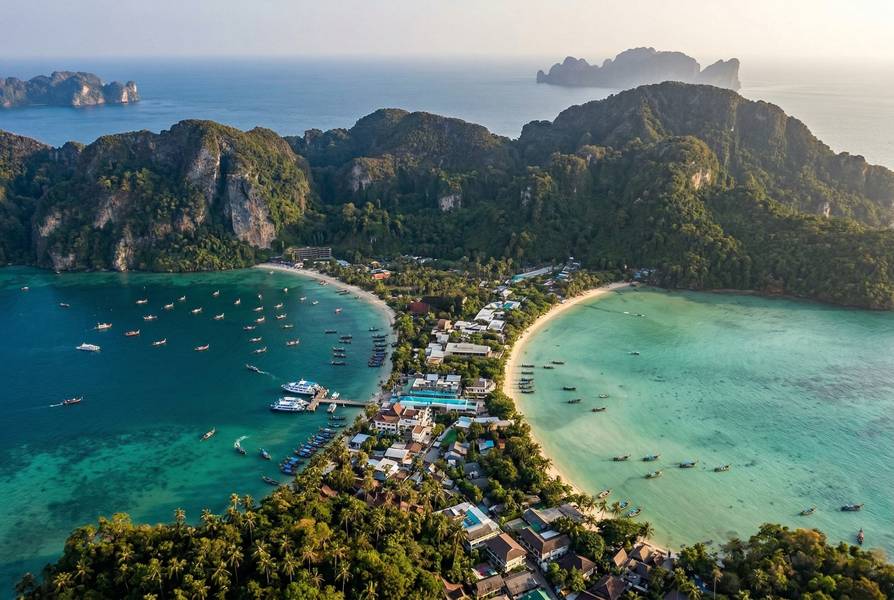
Koh Phi Phi is an archipelago of six limestone islands rising dramatically from the turquoise Andaman Sea, 42 kilometers from the Krabi coastline. Established as Thailand’s 46th national park in 1983, this 388 sq km marine protected area encompasses some of Thailand’s most iconic scenery—vertical limestone cliffs, pristine white-sand beaches, and vibrant coral reefs teeming with marine life.
Phi Phi Don is the main inhabited island, home to Tonsai Village with its hotels, restaurants, and car-free streets. Phi Phi Leh, the smaller uninhabited island, is home to the world-famous Maya Bay—made legendary by the 2000 film “The Beach.” Following a groundbreaking 4-year closure for ecosystem restoration (2018-2022), Maya Bay now operates as a global model for sustainable tourism, with over 100 blacktip sharks returning to its waters.
Beyond the beaches, Koh Phi Phi is a world-class diving destination with crystal-clear waters, diverse coral formations, and marine life ranging from leopard sharks to seahorses. The islands are also the only reliable location in Thailand to observe frigatebirds, including the critically endangered Christmas Island Frigatebird.
For medical tourists visiting Thailand, Phi Phi offers breathtaking natural beauty for those well into their recovery who can manage moderate physical activity. However, the remote island location means limited medical facilities and boat evacuation required for emergencies—patients requiring immediate medical access should consider day trips or choose mainland destinations.
Park fees, operating hours, and seasonal closures are subject to change. Verify current information through the official DNP website or your tour operator before booking. E-ticket purchase with passport details is required.
The Islands
The Phi Phi archipelago comprises six islands within the national park:
Koh Phi Phi Don (เกาะพีพีดอน)
The largest and only inhabited island, characterized by its distinctive hourglass shape connecting two mountains with a narrow isthmus. Key areas include:
- Tonsai Village: Main tourist hub with hotels, restaurants, dive shops, and ferry pier
- Loh Dalum Bay: Quieter bay on the western side, calm waters for swimming and bioluminescent plankton viewing
- Long Beach: Secluded southern beach with excellent snorkeling and clear waters
- Phi Phi Viewpoint: Iconic panoramic view from 186m elevation (343 steps)
- Monkey Beach: Long-tailed macaque habitat (observe from boats only)
Koh Phi Phi Leh (เกาะพีพีเล)
Uninhabited island of sheer limestone cliffs and hidden lagoons:
- Maya Bay: The famous beach from “The Beach” film—now heavily protected
- Pileh Lagoon: Enclosed emerald-green lagoon with dramatic cliffs
- Viking Cave (Tham Phaya Nak): 170m limestone cave with ancient wall paintings and swiftlet nest harvesting
- Loh Samah Bay: Excellent snorkeling with hard coral gardens
Smaller Islands
| Island | Thai Name | Features |
|---|---|---|
| Koh Mai Phai (Bamboo Island) | เกาะไม้ไผ่ | Pristine white beach, snorkeling |
| Koh Yung (Mosquito Island) | เกาะยุง | Marine sanctuary, diving |
| Bida Nok | บีดานอก | Premier dive site—sharks, rays, walls |
| Bida Nai | บีดาใน | Dive site—seahorses, ghost pipefish |
Natural Features & Ecology
Geology
The Phi Phi Islands are limestone karst formations dating to the Triassic period (~200-250 million years ago), created from ancient coral reef deposits. The distinctive vertical cliffs, honeycomb caverns, and sea caves are the result of millions of years of erosion by heavy tropical rainfall. This geological heritage connects to the dramatic karst landscapes of Ao Phang Nga and Krabi’s coastline.
Key geological features:
- Sheer limestone cliffs rising 30+ meters from the sea
- Viking Cave—170m cave cutting through Phi Phi Leh
- Pileh Lagoon—enclosed turquoise lagoon within limestone walls
- Underwater boulder and cave formations for diving
Marine Ecosystem
The warm Andaman waters around Phi Phi support exceptionally diverse marine life:
Coral Status
Following a significant bleaching event in 2024, ten dive sites were closed from May 2024 to April 2025 for recovery. The park’s willingness to implement temporary closures for conservation has proven highly effective—the Maya Bay closure allowed near-full reef recovery and the return of large marine species.
Coral Types:
- Hard corals: Pore coral, table coral, staghorn coral
- Soft corals: Sea fans, sea whips, barrel sponges
- Sea anemones hosting clownfish colonies
Marine Life Highlights
Sharks (returning to Phi Phi following conservation efforts):
- Blacktip reef sharks—100+ now regularly observed in Maya Bay
- Leopard sharks—common on eastern reefs
- Bamboo sharks—hiding under rocks and crevices
- Whale sharks—rare, occasionally seen February-May
Other Marine Life:
- Hawksbill and green sea turtles
- Blue-spotted rays and Kuhl’s stingrays
- Moray eels, sea snakes, octopus
- Seahorses and ghost pipefish (Bida Nai)
- Schools of barracuda, trevally, tuna
- Colorful reef fish: clownfish, parrotfish, angelfish, butterflyfish
Bird Life
Koh Phi Phi is designated an Important Bird Area (IBA) by BirdLife International and represents the only reliable location in Thailand to observe frigatebirds:
- Christmas Island Frigatebird (critically endangered globally)
- Lesser Frigatebird (regularly seen in large numbers)
- Black-naped Tern
- Bridled Tern
- Roseate Tern
- White-bellied Sea Eagle
Bioluminescent Plankton
Dinoflagellate plankton create magical blue sparkles in the water when disturbed at night. Best viewing:
- When: Dry season (November-April), around new moon
- Where: Loh Dalum Bay, Long Beach, waters around Phi Phi Leh
- Conditions: Dark, calm nights with minimal light pollution
- Reality check: Not a glowing sea like in movies—appears as sparkles or “underwater fireflies”
Bioluminescence is a natural phenomenon and sightings are never guaranteed.
Activities & Experiences
Snorkeling
| Location | Difficulty | Highlights | Post-Surgery Suitable |
|---|---|---|---|
| Loh Samah Bay | Easy-Moderate | Hard coral garden, anemones, 2-12m depth | Yes (Week 3+) |
| Pileh Lagoon | Easy | Calm enclosed lagoon, fish viewing | Yes (Week 2+) |
| Bamboo Island | Easy | White sand beach, shallow reef | Yes (Week 3+) |
| Shark Point | Moderate | Chance of shark sightings | Week 4+ (doctor approval) |
| Maya Bay (from boat) | Easy | Observe from designated boat areas—no beach snorkeling | Yes (Week 3+) |
Note: Snorkeling in Maya Bay itself is restricted to protect the reef. Most tours offer snorkeling at Loh Samah or Pileh instead.
Scuba Diving
Phi Phi offers diving for all levels, with multiple PADI dive centers on Phi Phi Don:
Beginner-Friendly Sites
| Site | Depth | Features |
|---|---|---|
| Loh Samah Bay | 2-12m | Hard coral garden, night dives, anemones |
| Bamboo Island | 5-18m | Shallow reef, colorful fish |
Advanced Sites
| Site | Depth | Current | Features |
|---|---|---|---|
| Koh Bida Nok | 8-28m | Moderate | Leopard sharks, underwater walls, soft corals |
| Koh Bida Nai | 8-28m | Moderate | Seahorses, ghost pipefish, macro life |
| Shark Point | 15-25m | Strong | Leopard sharks, barracuda |
| King Cruiser Wreck | 18-32m | Variable | Sunken car ferry, large fish |
Visibility: 10-30m (best November-April) Water Temperature: 28-30°C
Diving Medical Advisory: Scuba diving is NOT recommended during any post-surgery recovery period. Diving carries risks including decompression sickness, barotrauma, and physical exertion that can compromise healing. Honestly complete diving medical questionnaires and consult a dive physician if you have any health conditions.
Phi Phi Viewpoint Hike
The signature hiking experience on Phi Phi Don offers panoramic views of both Tonsai Bay and Loh Dalum Bay.
| Detail | Information |
|---|---|
| Distance | 0.9 miles (1.4 km) out-and-back |
| Steps | ~343 stairs |
| Elevation Gain | 403 feet (123m) to 186m summit |
| Difficulty | Moderate (challenging in heat) |
| Time | 30-45 minutes up, 20-30 minutes down |
| Surface | Mixed paved and dirt, steep stairs with railings |
| Entry Fee | 50 THB (Viewpoints 1-2), +20 THB for Viewpoint 3 |
| Best Time | Sunrise (fewest crowds) or late afternoon (sunset crowds) |
Three Viewpoints:
- Viewpoint 1: First platform, partial views
- Viewpoint 2: Main iconic photo spot—both bays visible
- Viewpoint 3: 15 minutes further, slightly different angle
What to Bring:
- Water (at least 1 liter)
- Proper footwear (no flip-flops)
- Sunscreen and hat
- Camera
Recovery Advisory: The Phi Phi Viewpoint hike is NOT recommended during post-surgery recovery due to steep stairs, physical exertion, and significant heat exposure. Cardiac patients should avoid this activity. If you have any health conditions, consult your doctor before attempting this hike.
Kayaking
- Available: Rental on Phi Phi Don, some hotels provide free kayaks
- Best areas: Loh Dalum Bay, around Phi Phi Don coast
- Post-surgery: Suitable for gentle paddling Week 3+ after minor procedures (avoid if shoulder/arm restrictions)
Longtail Boat Tours
Typical half-day itinerary: Maya Bay → Pileh Lagoon → Viking Cave (view from water) → Monkey Beach → Bamboo Island
Duration: 4-6 hours Cost: 1,500-3,000 THB depending on boat sharing vs. private charter
Bioluminescent Plankton Tours
Schedule: Depart at sunset, return late evening Best period: Dry season, new moon Cost: 800-1,500 THB
For Medical Tourists
Physical Requirements Assessment
| Factor | Level | Details |
|---|---|---|
| Ferry/Speedboat | Moderate | 1.5-2 hours, can be rough in swells |
| Walking (Tonsai Village) | Easy | Flat, paved paths |
| Beach Access | Easy-Moderate | Some require boat + wading |
| Viewpoint Hike | Challenging | 343 steps, steep, hot and humid |
| Snorkeling | Easy-Moderate | Swimming required; life jackets available |
| Boat Transfers | Moderate | Stepping on/off longtail boats |
| Heat Exposure | High | Tropical sun, limited shade on beaches |
| Mobile Signal | Good | In Tonsai Village; limited on tours |
Post-Surgery Suitability
| Procedure Type | Beach Relaxation | Snorkeling | Viewpoint Hike | Scuba Diving |
|---|---|---|---|---|
| Dental (extraction/implant) | Week 2+ | Week 3+ | NOT recommended | NOT recommended |
| LASIK | Week 2+ | Week 3+ | Week 4+ | NOT recommended* |
| Light cosmetic (Botox, fillers) | Week 2+ | Week 3+ | NOT recommended | NOT recommended |
| Rhinoplasty | Week 3+ | Week 4+ | NOT recommended | NOT recommended |
| Abdominal surgery | NOT recommended | NOT recommended | NOT recommended | NOT recommended |
| Cardiac procedures | Day trip only | NOT recommended | Contraindicated | Contraindicated |
| Orthopedic (knee/hip) | NOT recommended | NOT recommended | NOT recommended | NOT recommended |
*Diving after LASIK requires specific clearance and waiting periods—consult your ophthalmologist.
Critical Medical Advisory: Koh Phi Phi has LIMITED medical facilities—only small clinics capable of stabilizing patients before evacuation. Emergency evacuation to mainland hospitals requires 2+ hours by speedboat. Patients requiring immediate medical access should consider day trips from Krabi/Phuket only, or choose mainland destinations. Always consult your doctor before outdoor activities post-procedure.
Medical Facilities on Phi Phi
| Facility | Services | Contact |
|---|---|---|
| Doctor Phi Phi Takecare Clinic | 24/7 urgent care, medevac coordination | WhatsApp +66 950735550 |
| WorldMed Center | 24/7 emergency, consultations, insurance support | +66 95 424 0444 |
| Phi Phi Island Hospital | Government field hospital, basic services only | — |
Limitations: On-island facilities can stabilize patients only. Serious medical emergencies require speedboat or helicopter evacuation to mainland hospitals.
Nearest Full Hospitals
| Hospital | Location | Distance | Travel Time |
|---|---|---|---|
| Krabi Nakharin International Hospital | Krabi Town | ~45 km + ferry | 2-3 hours |
| Bangkok Hospital Phuket | Phuket | ~70 km + ferry | 2.5-3 hours |
Emergency Numbers:
- 1669: National Emergency Hotline
- 1155: Tourist Police
- 191: Police
- 199: Fire
Who Should NOT Stay Overnight on Phi Phi
- Patients with recent major surgery
- Cardiac patients (diving and strenuous activities contraindicated)
- Those requiring regular medical monitoring or medication refrigeration
- Anyone with mobility limitations (no vehicles, sandy/uneven terrain)
- Patients who may need emergency medical care
Who May Consider Visiting
- Patients 2-3+ weeks post minor procedures (with doctor approval)
- Those comfortable with limited medical access for emergencies
- Visitors who will skip hiking and limit to relaxed beach time
- Day-trippers returning to Krabi/Phuket accommodation each night
Getting There
From Bangkok
- Fly to Phuket (1h 20min) or Krabi (1h 25min)
- Transfer to pier:
- Phuket: Rassada Pier (48 km from airport)
- Krabi: Klong Jilad Pier (30 km from airport)
- Ferry/Speedboat to Phi Phi (1.5-2 hours)
Ferry from Phuket
| Departure | Type | Duration | Price (one-way) |
|---|---|---|---|
| 08:30, 11:00, 13:30, 13:45, 15:00 | Ferry | 2 hours | 450-700 THB |
| 08:30-14:00 (multiple) | Speedboat | 1 hour | 700-1,400 THB |
Major operators: Chao Koh Ferry, Andaman Wave Master, Phi Phi Ferry
Arrival: Tonsai Pier, Phi Phi Don (+20 THB pier fee)
Ferry from Krabi
- Departure: Klong Jilad Pier
- Duration: 1.5-4 hours depending on service
- Multiple operators available
On-Island Transport
- No vehicles: Phi Phi Don is car-free
- Walking: Tonsai Village is compact and walkable
- Longtail boats: For beach-hopping, 100-300 THB for short trips
- Long Beach/Laem Thong: Require boat access
Important Booking Requirements
- E-ticket mandatory (from October 2025): All park visitors must purchase entry through official DNP system with passport details
- Daily visitor limits: 4,125 maximum for Maya Bay—book in advance during peak season
- National park fee: 400 THB foreign adults, 200 THB children (not included in most tour prices)
Accommodation
On Phi Phi Don
| Area | Character | Best For |
|---|---|---|
| Tonsai Village | Central, convenient, lively | Ferry access, restaurants, nightlife |
| Loh Dalum Bay | Quiet bay, sunset views | Beach relaxation, bioluminescence |
| Long Beach | Secluded, peaceful | Snorkeling, quiet retreat |
| Laem Thong Beach | North end, isolated | Luxury resorts, away from crowds |
Price Range: Budget hostels (~$20) to luxury resorts ($300+)
Notable Hotels:
- SAii Phi Phi Island Village (5-star, northern Phi Phi)
- Villa 360 (hillside, pool)
- PP Princess Resort (beachfront)
Booking Tips:
- Book early for December-February (peak season)
- Lower prices June-October (monsoon—check ferry schedules)
- Tonsai most convenient; Long Beach/Laem Thong require boat transfers
Camping
Not permitted on any island (banned since 2016 for environmental protection).
Practical Tips
What to Pack
Essential:
- Reef-safe mineral sunscreen (zinc oxide/titanium dioxide only)
- Water shoes or sturdy sandals
- Rash guard (sun protection + jellyfish protection)
- Waterproof bag for electronics
- Cash (THB)—ATMs available but charge fees
- Motion sickness medication if prone
For Recovery Patients:
- Doctor’s contact information
- Hospital contact card
- Any prescribed medications
- Cooling towel
- Wide-brimmed hat
What NOT to Bring
| Prohibited Item | Consequence |
|---|---|
| Chemical sunscreen (oxybenzone, octinoxate) | Up to 100,000 THB fine |
| Single-use plastics | Confiscated |
| Styrofoam containers | Confiscated |
Water Safety
Currents: Strong during monsoon season (May-October)—dangerous for inexperienced swimmers
Jellyfish:
- Types present: Portuguese man o’ war, fire jellyfish, box jellyfish (rare)
- Higher risk: August-December
- Precautions: Heed warning flags, avoid swimming after dark, consider rash guard/stinger suit
Maya Bay: Swimming is PROHIBITED
Wildlife Safety
Monkeys (Monkey Beach):
- DO NOT feed monkeys—1,000 THB fine
- Keep 2-3 meters distance
- Do not bring food
- Bites require rabies shots
- Recommended: Observe from boat only
Snakes: Present but rarely encountered Insects: Mosquitoes (use repellent), sandflies on some beaches
Environmental Responsibility
Conservation Success Story
Maya Bay’s 4-year closure (2018-2022) is considered “one of the most successful marine actions in many years” globally. Results include:
- 100+ blacktip sharks returning to the bay
- Near-full coral recovery using organic replanting methods
- Daily visitors reduced from 7,000 to 375 per hour slot
- No swimming allowed in the bay
Visitor Rules
- NO swimming in Maya Bay
- Maximum 1-hour visit to Maya Bay
- No feeding wildlife—1,000 THB fine
- No touching coral or marine life
- No anchoring on coral—mooring buoys only
- Reef-safe sunscreen required
- No single-use plastics in park
- No drones without DNP permit
Conservation Programs
- Maya Bay Rehabilitation Project: Organic coral replanting
- Marine Discovery Center (SAii resort): Clownfish and bamboo shark reintroduction
- Ocean Quest Global Rehabilitation Program
- Monthly island cleanings: 10th, 20th, 30th of each month
Ethical Wildlife Interaction
- Monkey Beach: Observe from boat only—do not land or feed
- Diving: Use PADI Eco-Dive certified operators
- Tours: Choose operators who follow park regulations and don’t harass wildlife
Seasonal Guide
| Month | Conditions | Maya Bay | Notes |
|---|---|---|---|
| Jan | Peak season, excellent weather, clear seas | Open | Highest prices, book ahead |
| Feb | Driest month, ideal diving visibility | Open | Peak demand |
| Mar | Hot, dry, great conditions | Open | Slightly less crowded |
| Apr | Hottest month (up to 36°C) | Open | Shoulder season pricing |
| May | Monsoon begins, some rough seas | Open | Lower prices |
| Jun | Low season, rainy, some closures | Check status | Quieter, cheaper |
| Jul | Rainy with sunny periods | Check status | Thai domestic visitors |
| Aug | Monsoon, rough seas | CLOSED | Coral recovery period |
| Sep | Wettest month, roughest seas | CLOSED | Lowest prices |
| Oct | Monsoon waning, still wet | Reopens ~Oct 1 | Weather improving |
| Nov | High season starts, calm seas | Open | Great conditions |
| Dec | Peak season, Christmas rush | Open | Best weather, book early |
Nearby Attractions
Other Islands
- Koh Lanta: 2-3 hours by boat—laid-back island with beaches and diving
- Railay Beach: Krabi mainland—dramatic cliffs, rock climbing
- Koh Jum/Koh Ngai: Quieter alternative islands
Day Trip Options
Phi Phi is accessible as a day trip from:
- Phuket: 2 hours by ferry
- Krabi/Ao Nang: 1.5 hours by speedboat
- Koh Lanta: 1.5-2 hours by boat
Premier Dive Sites (Liveaboard)
- Hin Daeng (Red Rock): Best in Thailand for pelagics, manta rays
- Hin Muang (Purple Rock): Deep walls, whale sharks
- Koh Haa: Underwater cathedral caves, excellent visibility
Useful Thai Phrases
| English | Thai | Pronunciation |
|---|---|---|
| Hello | สวัสดี | Sa-wat-dee |
| Thank you | ขอบคุณ | Khob khun |
| How much? | เท่าไหร่ | Thao rai? |
| Phi Phi Islands | เกาะพีพี | Goh Pee Pee |
| Maya Bay | อ่าวมาหยา | Ao Ma-ya |
| Beautiful | สวย | Suay |
| Reef-safe sunscreen | ครีมกันแดดปลอดภัยต่อปะการัง | Cream gan daet plod pai tor pa-ga-rang |
| No plastic | ไม่เอาพลาสติก | Mai ao plastic |
Contact Information
National Park
- Park Name: Hat Noppharat Thara – Mu Ko Phi Phi National Park
- Phone: +66 75 602 163
- Website: https://portal.dnp.go.th/
- E-ticket System: Required for all visitors
Emergency Numbers
- 1669: National Emergency Hotline
- 1155: Tourist Police
- 191: Police
- 199: Fire
Medical (On-Island)
- Doctor Phi Phi Takecare Clinic: WhatsApp +66 950735550 (24/7)
- WorldMed Center: +66 95 424 0444 (24/7)
Frequently Asked Questions
Is Koh Phi Phi safe to visit after medical procedures?
Beach relaxation on Phi Phi Don is suitable 2-3+ weeks after minor procedures (dental, cosmetic) with doctor approval. However, the Phi Phi Viewpoint hike (343 steep steps) is NOT recommended during recovery. The islands have LIMITED medical facilities—only small clinics that can stabilize patients before evacuation to mainland hospitals (2+ hours by speedboat). Patients requiring immediate medical access should choose destinations closer to Krabi or Phuket hospitals. Diving is NOT recommended during any recovery period due to physical demands and decompression risks.
When is Maya Bay closed?
Maya Bay closes August 1 - September 30 each year for coral reef recovery and marine ecosystem restoration. Some areas of the park may close earlier (June-July) during monsoon season. This annual closure has been instrumental in the bay's remarkable recovery, with over 100 blacktip sharks now returning to the waters.
Can I swim at Maya Bay?
No. Swimming in Maya Bay is PROHIBITED to protect the recovering coral reef ecosystem. Visitors can walk on the beach (maximum 1-hour visit) and snorkel from boats in designated areas nearby. This is part of Thailand's most successful marine conservation initiative, reducing daily visitors from 7,000 to 375 per hour slot.
Do I need to book Maya Bay tickets in advance?
Yes. Since October 2025, all visitors must purchase park entry e-tickets through the official DNP system with passport details before visiting. Daily visitor limit is 4,125 people (375 per hour slot). Book in advance during high season (December-April) as slots fill quickly. National park fee is 400 THB for foreign adults, 200 THB for children.
Is mobile phone signal available on Phi Phi?
Yes, mobile coverage is good in Tonsai Village and developed areas of Phi Phi Don. However, signal can be limited or unavailable on boat tours, remote beaches, and the smaller islands. This is important for medical tourists to consider for emergency communication planning.
Is the Phi Phi Viewpoint hike difficult?
The hike involves 343 steep steps with mixed paved and dirt surface, taking 30-45 minutes one way. It is rated moderate difficulty but challenging in hot, humid conditions. Railings are provided on steep sections. Entry fee is 50 THB for Viewpoints 1-2, additional 20 THB for Viewpoint 3. NOT recommended for cardiac patients or those in post-surgery recovery due to physical exertion and heat exposure.
When is the best time to see bioluminescent plankton?
Bioluminescent plankton (dinoflagellates) are best viewed during the dry season (November-April) on dark nights around the new moon. Prime viewing locations include Loh Dalum Bay and Long Beach on Phi Phi Don. Evening boat tours are available. Note that bioluminescence is a natural phenomenon and sightings are never guaranteed—it appears as blue sparkles when water is disturbed, not a glowing sea like in movies.
Are there jellyfish at Phi Phi?
Yes. Jellyfish including Portuguese man o' war, fire jellyfish, and rarely box jellyfish are present, particularly August-December. Heed warning flags on beaches, avoid swimming after dark, stay in designated swim areas, and consider wearing a rash guard or stinger suit. Chemical sunscreens containing oxybenzone and octinoxate are BANNED in Thai marine parks—use reef-safe mineral sunscreen only.
Should I visit Monkey Beach?
We recommend observing monkeys from your boat only. The long-tailed macaques at Monkey Beach have become aggressive due to years of tourist feeding. Feeding wildlife is illegal (1,000 THB fine) and dangerous—several hundred tourists require hospital treatment for monkey bites annually. Bites require rabies shots. If visiting, keep 2-3 meters distance and do not bring food.
Need Help Planning Your Visit?
Our team can help coordinate your visit to Koh Phi Phi (Hat Noppharat Thara – Mu Ko Phi Phi National Park) during your stay in Thailand.
Check your insurance coverage before booking your medical trip.