
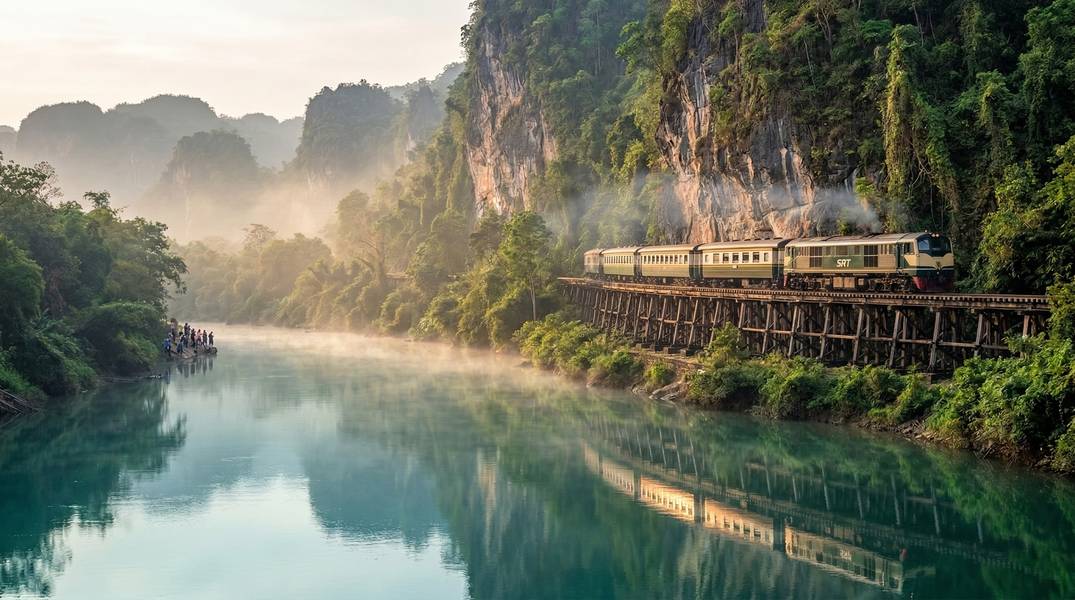
Sai Yok National Park
Overview
อุทยานแห่งชาติไทรโยค • Sai Yok National Park
Established in 1980 as Thailand’s 19th national park, Sai Yok protects 500 sq km of limestone karst mountains, mixed deciduous forest, and the valley of the Khwae Noi River — the real River Kwai. Part of the Western Forest Complex, one of the largest continuous protected forest areas in Southeast Asia (18,730 sq km across 19 protected sites), this park offers a distinctive combination of river-based nature experiences and WWII history.
For medical tourists, Sai Yok provides a genuinely unique recovery environment. Floating raft houses on the river offer a restorative stay with minimal physical demand. River boat rides along soaring limestone cliffs, waterfall viewing from a flat suspension bridge, and the chance to witness the world’s smallest mammal — Kitti’s hog-nosed bat — emerging at dusk make this park accessible even during early recovery stages.
The park was originally established specifically to help conserve Kitti’s hog-nosed bat habitat, and its limestone caves, river cliffs, and forest ecosystems remain critical wildlife corridors along the Thailand-Myanmar border.
Important: Park fees, hours, and trail conditions are subject to change. Verify current information with the park office before your visit. Wildlife sightings cannot be guaranteed.
Why Sai Yok is Special
World’s Smallest Mammal
Kitti’s hog-nosed bat (Craseonycteris thonglongyai), also called the bumblebee bat, was discovered in 1973 by Thai zoologist Kitti Thonglongya. At just 29-33 mm body length and approximately 2 grams, it’s the world’s smallest bat and arguably the world’s smallest mammal. The species is the sole member of its own family, Craseonycteridae.
Key facts:
- IUCN Status: Near Threatened (2019 review, downward population trend)
- Known habitat: Fewer than 50 limestone caves — approximately 30 in Thailand and 15 in Myanmar
- Average colony size: ~100 individuals
- Behavior: Feeds during brief activity periods at dusk and dawn, echolocating at 70-80 kHz
Sai Yok National Park was established in 1980 partly to conserve this species. Caves near the visitor center house active colonies.
Extraordinary Endemism
Sai Yok District sits at the biogeographical boundary between Indo-Chinese and Malayan zoogeographical subregions at the discontinuity of the Tanen Taunggyi Range. This position has produced remarkable endemism:
- Kanburi pit viper (Trimeresurus kanburiensis) — endemic venomous snake found only in Sai Yok District
- Queen crab (Poo Rachinee) — red, white, and blue colored freshwater crab found only in Sai Yok’s streams
- Yellow-headed gecko (Cnemaspis huaseesom) — endemic gecko species
- Bold-banded gecko (Cyrtodactylus tigroides) — endemic gecko species
- Red-eyed gecko (Gekko nutaphandi) — endemic gecko species
At least 7 squamate species are believed endemic to the district.
WWII Heritage
The park contains remains of the Burma-Thailand Death Railway, built with forced labor during World War II (250,000+ Southeast Asian civilians and 12,000+ Allied POWs). Hellfire Pass Memorial Museum, 19 km south of the visitor center, is maintained by the Government of Australia and provides a powerful historical experience through multimedia displays, artifacts, and POW audio testimonies.
Natural Features & Ecology
Landscape & Geography
The park’s terrain is defined by the limestone karst mountains of the Tenasserim Range, bisected by the Khwae Noi River valley. Steep limestone cliffs line the river, with extensive cave systems penetrating the mountains. Elevation ranges from 100m along the river to 1,328m at Khao Ro Rae near the Myanmar border.
Forest Types:
- Mixed deciduous forest (85% of park area)
- Dry evergreen forest (13%)
- Dry dipterocarp forest (2%)
- Bamboo forest (interspersed throughout mountains)
- Teak forest along the Khwae Noi River (replanted in 1954 after WWII-era deforestation)
Wildlife
Mammals: Asian elephant, Indochinese tiger (critically endangered, extremely rare), leopard, leopard cat, Asiatic wild dog (dhole), sambar deer, barking deer, wild pig, gibbon, slow loris, Indochinese serow, macaque species, Malayan porcupine, and flying squirrel.
Note: Large mammal sightings (elephants, tigers) are extremely rare near the visitor center due to tourism activity. Deep forest areas are more productive for wildlife, but these require extended treks. Wildlife encounters are never guaranteed.
Birds
The park hosts between 105 and 209 bird species (sources vary; the park has not been heavily surveyed, so the true count is likely higher).
Notable Species:
- Great hornbill and Oriental pied hornbill
- Crested serpent eagle and Rufous-bellied eagle
- Greyish limestone babbler
- Grey-headed parakeet
- White-rumped shama
- Common green magpie
- Greater and Lesser necklaced laughingthrush
- Eastern barn owl
Best Birdwatching: Early morning (05:30-07:00) along forest trails near the visitor center. The park is underbirded — patient observers may find species not yet recorded.
Geological Features
- Limestone karst formations of the Tenasserim Range
- Extensive cave systems with stalactites and stalagmites
- River-cut limestone cliffs along the Khwae Noi
- Hot springs in the wider Kanchanaburi region
Water Features
- Sai Yok Yai Waterfall — 8m cascade flowing directly into the Khwae Noi River, accessible via flat suspension bridge
- Sai Yok Lek Waterfall — larger waterfall (despite the name meaning “small”), located 300m downstream
- Khwae Noi River (River Kwai) — the main river flowing through the park
- Small streams near the campsite — habitat for the endemic queen crab
Caves
Lawa Cave (Tham Lawa)
One of the most impressive caverns in Kanchanaburi Province.
| Detail | Information |
|---|---|
| Total Length | 500 meters (5 large chambers) |
| Lit Trail | 280m walking trail through several chambers |
| Difficulty | Moderate — uneven terrain inside cave |
| Access | By boat from Pak Saeng Pier (south off Route 323) |
| Highlights | Impressive stalactites and stalagmites, dimly lit atmospheric chambers |
| Duration | ~1 hour |
Daowadung Cave (Tham Daowadung)
| Detail | Information |
|---|---|
| Length | 240 meters (8 chambers) |
| Difficulty | Moderate-challenging — no stairs, slippery entrance |
| Access | 6 km from park entrance by road (300 THB return by tuk-tuk) or by boat (1,000 THB return + 1.5 km uphill walk) |
| Guide | Ranger accompaniment available (tip appreciated) |
| Inhabitants | Bats, cave crickets, snakes |
| Duration | 1-2 hours |
Warning: The entrance to Daowadung Cave is treacherous when wet. There are no stairs — visitors must navigate uneven rock surfaces. Not recommended for visitors with limited mobility or during early post-surgery recovery. Wear closed-toe shoes with good grip.
Khang Khao Cave (Bat Cave)
| Detail | Information |
|---|---|
| Difficulty | Easy |
| Access | Short walk from visitor center |
| Duration | 30 minutes |
| Highlights | Kitti’s hog-nosed bat colony |
Bat Conservation Guidelines:
- Do not enter during daytime roosting hours
- No flash photography
- Minimize noise near cave entrances
- Best observed: dusk emergence (~17:30-18:30) from the cave entrance
Activities & Experiences
River Activities
| Activity | Difficulty | Duration | Cost | Post-Surgery Suitability |
|---|---|---|---|---|
| Longtail boat to Sai Yok Lek | Easy (seated) | 30 min | 300 THB | Suitable Week 1+ |
| River boat trip (limestone cliffs) | Easy (seated) | 45 min | 400 THB | Suitable Week 1+ |
| Swimming at Sai Yok Yai | Easy-moderate | Variable | Included with entry | Week 3+, doctor approval (avoid with open wounds) |
| Kayaking/paddling | Moderate | Variable | Varies | Not recommended during recovery |
River boat rides along the Khwae Noi offer soaring limestone cliff views with zero physical exertion — ideal for early-stage recovery patients.
Water Safety: River currents strengthen significantly during monsoon season (May-October). Do not swim during high water. Always use a life jacket on boats.
Hiking
| Trail | Distance | Difficulty | Time | Guide Required | Recovery Suitability |
|---|---|---|---|---|---|
| Nature Trail (near Sai Yok Yai) | 1 km | Easy | 30-45 min | No | Week 2+ |
| Sai Yok Lek-Sai Yok Yai Trail | ~2 km | Easy-moderate | 1-1.5 hr | No | Week 3+ |
| Phu Toei Raft Trail | 6 km (3.7 mi) | Moderate | 2-3 hr | No | Not during recovery |
| Visitor Centre area trails | Various short | Easy | Variable | No | Week 2+ |
Note: Trails can be overgrown seasonally. The Phu Toei Raft Trail (rated 4.3/5 on AllTrails with 209m elevation gain) is the best-rated hiking trail in the park but is not suitable for recovery patients.
Wildlife Watching
| Target | Best Time | Best Location | Likelihood |
|---|---|---|---|
| Kitti’s hog-nosed bat | Dusk (17:30-18:30) | Caves near visitor center | Good (seasonal) |
| Great hornbill | Early morning | Forest canopy | Moderate |
| Queen crab | Daytime | Streams near campsite | Good (in season) |
| Gibbons | Early morning (05:30-07:00) | Deep forest | Low-moderate |
Photography
Best spots:
- Sai Yok Yai waterfall from the suspension bridge
- Limestone cliffs from a river boat
- Sunrise mist over the Khwae Noi River from raft houses (November-January)
- Daowadung Cave formations
- Queen crabs at campsite streams
Historical Interest
| Site | Distance | Description |
|---|---|---|
| Death Railway remains | Within park | Original railway track sections |
| Hellfire Pass Memorial Museum | 19 km south | Australian-maintained museum with walking trails through the 75m-long, 25m-deep rock cutting |
| Bridge on the River Kwai | ~100 km (Kanchanaburi town) | Iconic WWII landmark |
| JEATH War Museum | ~100 km (Kanchanaburi town) | POW camp replica museum |
| Kanchanaburi War Cemetery | ~100 km (Kanchanaburi town) | Allied war graves |
The Hellfire Pass Memorial Museum includes a short trail (~30 minutes) and a long trail (up to 3 hours) through the actual cutting and railway bed. The museum features multimedia displays and POW audio testimonies. Physically manageable for most recovery patients on the short trail.
For Medical Tourists
Physical Requirements Assessment
| Factor | Level | Details |
|---|---|---|
| Walking Distance | Variable | 0 km (boat rides only) to 6 km (Phu Toei trail) |
| Elevation | 100-200m (visitor areas) | No altitude concerns for medical tourists |
| Temperature | 15-31°C (seasonal) | March-May can reach 35°C |
| Shade | Good on forest trails | Limited at river viewpoints |
| Rest Areas | Good | Restaurants, cafes at visitor center; floating restaurants near waterfall |
| Mobile Signal | Limited | Good at visitor center; weak to none elsewhere |
Recovery Week Recommendations
| Activity | Difficulty | Earliest Safe | Ideal Week | Key Considerations |
|---|---|---|---|---|
| River boat rides | Easy | Week 1 | Week 1+ | Seated, no exertion; ideal early recovery |
| Waterfall viewing (bridge) | Easy | Week 1 | Week 1+ | Flat suspension bridge, short walk |
| Raft house overnight | Easy | Week 1 | Week 1+ | Unique rest experience; basic facilities |
| Bat emergence viewing | Easy | Week 1 | Week 1+ | Short walk to cave entrance, standing/sitting |
| Nature Trail (1 km) | Easy | Week 2 | Week 2-3 | Well-signposted, gentle walk |
| Lawa Cave (lit trail) | Moderate | Week 3 | Week 3+ | 280m walkway; uneven terrain |
| Sai Yok Lek-Yai trail | Easy-moderate | Week 3 | Week 3+ | 2 km; can be overgrown |
| Daowadung Cave | Moderate-challenging | N/A | N/A | Not recommended during recovery |
| Phu Toei Raft Trail | Moderate | N/A | N/A | Not recommended during recovery |
Procedure-Specific Guidance
| Procedure Type | Earliest Visit | Recommended Activities |
|---|---|---|
| Dental (simple) | Week 1 | Boat rides, waterfall viewing, raft house stay |
| Dental implant | Week 2 | Boat rides, nature trail, bat watching |
| LASIK | Week 2 | All easy activities; sunglasses for river glare |
| Minor cosmetic | Week 2 | Boat rides, nature trail, Hellfire Pass Museum |
| Rhinoplasty | Week 2 | Boat rides, raft house stay; avoid dusty caves |
| Abdominal surgery | Week 3 | Boat rides; avoid climbing and cave exploration |
| Orthopedic (minor) | Week 3 | Boat rides only; uneven terrain unsuitable |
| Cardiac procedures | Week 4+ | Consult cardiologist; avoid heat and exertion |
| Hip/knee replacement | Week 6+ | Doctor approval required; boat rides only |
Medical Advisory: Consult your treating physician before outdoor activities post-surgery. Sai Yok is remote — the nearest quality hospital (Synphaet Hospital Kanchanaburi or Paholpolpayuhasena Hospital) is approximately 100 km away (1.5-2 hours by car). A district hospital is closer (~20-30 km) but has limited capabilities. Inform your recovery team about limited mobile signal within the park.
Why Sai Yok Suits Medical Tourists
- Low-exertion activities: River boats, waterfall viewing, and raft houses require minimal physical effort
- Unique experience: Floating raft house stays offer genuinely restorative riverine rest
- Wildlife without hiking: Bat emergence viewable from cave entrance near visitor center
- Cultural depth: Hellfire Pass Museum adds meaningful experience without physical strain
- Combinable: Can be paired with Erawan Falls for a multi-day Kanchanaburi trip
- Train journey: The Bangkok-Nam Tok railway over the River Kwai bridge is an experience itself
Nearest Hospitals
| Hospital | Distance | Travel Time | Type | Key Services |
|---|---|---|---|---|
| Sai Yok Hospital | ~20-30 km | 30-45 min | District (limited) | Basic emergency care |
| Synphaet Hospital Kanchanaburi | ~100 km | 1.5-2 hr | Private (AACI accredited) | 24-hour emergency, specialist care |
| Paholpolpayuhasena Hospital | ~100 km | 1.5-2 hr | Government | Full services, leading government hospital |
Synphaet Hospital Kanchanaburi: First hospital in Asia with AACI accreditation. 24-hour emergency department with emergency medicine specialists. Phone: 034-912-888.
Emergency Contacts:
- National Emergency: 1669
- Park Visitor Center: +66 34 686 024
- Park Mobile: +66 89 028 1958
Getting There
From Bangkok by Car (Recommended)
| Detail | Information |
|---|---|
| Distance | ~240 km |
| Duration | 3.5 hours |
| Route | Highway 323 to park entrance |
A car provides the most flexibility for exploring the park and visiting Hellfire Pass and other nearby attractions.
From Bangkok by Train
| Detail | Information |
|---|---|
| Route | Thonburi (Bangkok Noi) Station → Nam Tok Station |
| Distance | ~195 km |
| Duration | ~5 hours |
| Departure | 07:50 (arrives ~12:35) |
| Highlight | Crosses Bridge on the River Kwai and Wang Pho Viaduct |
The train journey is a scenic experience in itself. From Nam Tok Station, take a bus (33 km) to the park.
From Bangkok by Bus
- Bus from Bangkok to Kanchanaburi (~2.5 hours)
- Kanchanaburi to Thong Pha Phum bus (fan/AC 55-75 THB, every 30-45 min, 1.5 hours)
Last-Mile Transport
- Motorcycle taxi from Highway 323 to visitor center (3 km)
- Longtail boat charter from Kanchanaburi up the Khwae Noi River
- Boat from Pak Saeng Pier (Ban Tha Sao) to Lawa Cave area
Road Conditions
Paved highway (Route 323) to the park entrance. Internal park roads are adequate. Side roads may be affected during rainy season.
Accommodation
Inside the Park (DNP)
Bungalows (Book via DNP website nps.dnp.go.th, 7-60 days in advance):
| Option | Capacity | Price (THB) |
|---|---|---|
| Sai Yok 105 (Wiman Phrai) | 4 pax, 2 bedrooms | 800 |
| Sai Yok 201 (Klang Dong) | 4 pax, 2 bedrooms | 1,500 |
| Sai Yok 202 (Phong Phrai) | 4 pax, 2 bedrooms | 1,500 |
| Sai Yok 203 (Sai Yoi) | 6 pax, 3 bedrooms | 1,800 |
| Sai Yok 204 (Roi Pa) | 7 pax, 3 bedrooms | 2,100 |
| Sai Yok 205 (Phanasan) | 7 pax, 3 bedrooms | 2,100 |
- 20% discount Monday-Thursday
- Payment within 2 days or auto-cancel
- Payment at 7-Eleven or bank (Mon-Fri before 15:30)
- Foreign visitors: transfer to Krung Thai Bank #039-6-02816-0, email np_income@dnp.go.th with booking code
- Maximum 3 days per booking
Camping:
| Item | Price (THB/day) |
|---|---|
| Tent rental (2-person) | 225 |
| Sleeping set (bag, mat, pillow) | 60/person |
| Own tent | 30 |
Accommodation prices subject to change. Verify current rates on the DNP booking portal.
Floating Raft Houses
River Kwai Jungle Rafts — Luxury bamboo raft resort with kerosene lamp ambiance, private en-suite bathrooms, hot water. Activities include bamboo rafting to Sai Yok Yai waterfall. Mid-high price range.
The Float House River Kwai — Boutique floating villas with modern amenities (flat-screen TV, private sun deck, day beds, Wi-Fi). Thai folk-style architecture surrounded by tropical forest. High price range.
Boutique Raft Resort — Rooms on floating raft and main building. Swimming pool, Wi-Fi, air conditioning, hot shower, room service. Mid-high price range.
Sai Yok View Raft — Budget-mid option with bungalows on the river from 1,700 THB/night. Also has resort-style rooms.
Raft House Notes: Basic raft houses typically have electricity only 18:00-06:00. No air conditioning — the river provides natural cooling. Mosquitoes are generally not an issue on the water. Book well in advance for December-February peak season.
Practical Tips
What to Bring
Essential:
- Sturdy closed-toe shoes with good grip (critical for caves and trails)
- Long pants and long-sleeved shirt (leeches in wet season, thorny vegetation)
- Water (minimum 1.5L per person)
- Insect repellent (especially for dusk/dawn; important near bat caves)
- Rain jacket (year-round)
- Flashlight/headlamp (for caves and raft houses without nighttime lighting)
- Cash (THB) for park fees, boats, and food
- Offline maps (limited mobile signal)
Rainy Season Additions (May-October):
- Leech socks (tuck trousers into socks)
- Waterproof bag for electronics
- Change of clothes
- Quick-dry towel
For Recovery Patients:
- Prescribed medications (full supply — no pharmacies nearby)
- Hospital contact card with emergency numbers
- Cooling towel for hot weather (March-May)
- Light snacks and electrolyte drinks
- Comfortable cushion for boat rides
What NOT to Bring
National park regulations prohibit:
- Single-use plastic bags (under 36 microns) — fine up to 100,000 THB
- Plastic food containers, cups, straws, cutlery — fine up to 100,000 THB
- Styrofoam containers — fine up to 100,000 THB
- Sunscreens containing Oxybenzone, Octinoxate, 4-Methylbenzylidene Camphor, or Butylparaben — fine up to 100,000 THB
Use mineral-based sunscreen (zinc oxide or titanium dioxide). Park staff may hold banned sunscreens at the entrance for return on exit. These regulations apply to all Thai national parks, not just marine parks.
Snake & Wildlife Safety
- Kanburi pit viper: Highly venomous, arboreal, nocturnal — low encounter risk on main trails during daytime
- Cave racers: Non-venomous snakes found in caves; startling but harmless
- Wear closed shoes, use a flashlight at night, and stay on marked trails
- Do not feed wildlife
- Maintain distance from all animals
Leech Guidance (Wet Season)
Leeches are common in wet forest during June-October. They are medically harmless but unpleasant:
- Tuck trousers into socks
- Apply insect repellent to shoes and lower legs
- Check yourself periodically on trails
- Carry salt or a lighter to detach leeches (pulling can leave mouthparts embedded)
Environmental Responsibility
Park Rules
Sai Yok is part of the Western Forest Complex, a critical wildlife corridor. Follow all park regulations:
- No feeding wildlife — disrupts natural behavior and endangers animals
- No collecting — plants, animals, rocks, and soil must remain in the park
- No littering — carry out all waste
- Stay on marked trails — protects vegetation and nesting areas
- No flash photography in bat caves — causes distress to endangered bats
- Minimize noise near cave entrances during bat roosting hours
Ethical Wildlife Guidelines
- Kitti’s hog-nosed bat: Do not enter caves during roosting hours. Observe from cave entrance during dusk emergence only.
- No elephant riding — not offered in the park and not promoted as ethical tourism
- Report injured wildlife to park rangers
Conservation Context
- Sai Yok was established in 1980 specifically to conserve Kitti’s hog-nosed bat habitat
- Part of the Western Forest Complex — one of Southeast Asia’s largest continuous protected areas
- Ongoing teak reforestation program (since 1954) along the Khwae Noi River
- Some Kitti’s bat populations exist outside park boundaries and lack protection
Seasonal Guide
Month-by-Month Conditions
| Month | Conditions | Temperature | Medical Tourist Rating |
|---|---|---|---|
| January | Cool and dry, morning river mist | 20-30°C | Excellent |
| February | Cool and dry, waterfall flow declining | 22-32°C | Excellent |
| March | Warming, hot afternoons | 25-35°C | Good (heat caution) |
| April | Hot season peak, limited waterfall flow | 28-36°C | Fair (heat caution) |
| May | Monsoon begins, forest greening | 26-34°C | Fair |
| June | Regular afternoon rain, good waterfall flow | 25-33°C | Fair (leeches active) |
| July | Strong waterfall flow, lush forest | 25-32°C | Fair (some caves may close) |
| August | Strong waterfalls, rising river | 25-32°C | Not recommended (caves flood) |
| September | Heaviest rainfall, strong currents | 24-31°C | Not recommended |
| October | Heavy rain tapering, spectacular waterfalls | 25-32°C | Fair (late month) |
| November | Cool season starts, excellent waterfall flow | 22-31°C | Excellent |
| December | Best overall month, morning mist | 20-30°C | Excellent |
Best Months for Specific Activities
| Activity | Best Months | Notes |
|---|---|---|
| Raft house stays | Nov-Feb | Cool nights, morning mist, dry conditions |
| Bat watching | Year-round | Dusk emergence consistent |
| Waterfall viewing | Jul-Oct | Maximum flow (but access may be limited) |
| Hiking | Nov-Feb | Dry trails, pleasant temperatures |
| River boat trips | Nov-Apr | Calm water, safe conditions |
| Photography (mist) | Nov-Jan | Morning river mist for atmospheric shots |
| Cave exploration | Nov-Apr | Caves dry and accessible |
| Birdwatching | Nov-Apr | Deciduous forest opens canopy views |
Seasonal Warnings
Monsoon Season (May-October):
- River level rises significantly with strong currents
- Caves may flood — check with rangers before visiting
- Trails can be slippery
- Leeches active in forest
- Some raft houses may be difficult to access
Hot Season (March-May):
- Temperatures may exceed 35°C
- Heat exhaustion risk for recovery patients
- Visit early morning only
- Stay hydrated
Nearby Attractions
Nature Sites
| Attraction | Distance | Highlights |
|---|---|---|
| Erawan National Park | ~50 km east | Seven-tiered emerald waterfall, swimming pools |
| Khuean Srinagarindra NP | Northeast | Sri Nakharin Dam, Huai Mae Khamin Waterfall |
| Thong Pha Phum NP | North | Mountain forests |
| Hindad Hot Springs | ~60 km north (Thong Pha Phum) | Natural hot springs (therapeutic link) |
Historical & Cultural Sites
| Attraction | Distance | Highlights |
|---|---|---|
| Hellfire Pass Memorial Museum | 19 km south | WWII museum + walking trails |
| Bridge on the River Kwai | ~100 km | Iconic WWII bridge, Kanchanaburi town |
| JEATH War Museum | ~100 km | POW camp replica |
| Kanchanaburi War Cemetery | ~100 km | Allied war graves |
| Thailand-Burma Railway Centre | ~100 km | Comprehensive WWII railway history |
Dining
Floating restaurants near Sai Yok Yai waterfall serve Thai cuisine. Cafes at the visitor center offer basic meals and refreshments. Resort restaurants at raft houses provide meal packages.
Entry Fees
| Visitor Type | Fee |
|---|---|
| Foreign adult | 300 THB (~$8.50 USD) |
| Foreign child | 150 THB |
| Thai adult | 60 THB |
| Thai child | 30 THB |
| Motorcycle | 20 THB |
| Car | 30 THB |
Additional Activity Fees:
| Activity | Cost |
|---|---|
| Longtail boat to Sai Yok Lek | 300 THB |
| River boat trip (45 min, limestone cliffs) | 400 THB |
| Long-tail boat rental | 400-500 THB per half hour |
| Tuk-tuk to Daowadung Cave (return) | 300 THB |
| Boat to Daowadung Cave (return) | 1,000 THB |
Prices subject to change without notice. Sai Yok is a Category 3 national park under DNP pricing. Carry your receipt for inspection within the park. Cash payment at park entrance; DNP online booking accepts bank transfer and 7-Eleven payment.
Useful Thai Phrases
| English | Thai | Pronunciation |
|---|---|---|
| Hello | สวัสดี | Sa-wat-dee |
| Thank you | ขอบคุณ | Khob khun |
| How much? | เท่าไหร่? | Thao rai? |
| National park | อุทยานแห่งชาติ | Ut-tha-yan haeng chat |
| Waterfall | น้ำตก | Nam tok |
| Cave | ถ้ำ | Tham |
| Bat | ค้างคาว | Khang khao |
| River | แม่น้ำ | Mae nam |
| Help! | ช่วยด้วย! | Chuay duay! |
Safety Summary
- Caves: Slippery surfaces; Daowadung has no stairs. Ranger accompaniment available. Check flooding status during rainy season.
- River: Strong currents during monsoon. No swimming during high water. Always wear life jackets on boats.
- Wildlife: Maintain safe distance. Kanburi pit viper is venomous but nocturnal — low daytime risk on trails.
- Trails: Stick to marked paths. Leeches active May-October. Wear closed shoes.
- Weather: Prepare for sudden rain. Flash flooding possible during monsoon. Caves flood.
- Communication: Limited mobile signal. Download offline maps. Inform someone of your plans.
- Medical: Nearest quality hospital is 1.5-2 hours away. Carry emergency contacts and medications.
Disclaimer: Outdoor activities involve inherent risks. Weather conditions, trail conditions, and wildlife behavior are unpredictable. Medical tourists should consult their physician before visiting. Park fees, hours, and regulations may change without notice. Wildlife sightings cannot be guaranteed. Information based on available sources as of early 2026 — verify current conditions with the park office before your visit.
Frequently Asked Questions
Is Sai Yok National Park suitable for medical tourists recovering from procedures?
Yes, with appropriate activity selection. River boat rides and waterfall viewing from the suspension bridge require minimal exertion and are suitable from Week 1-2 post-minor procedures. Gentle nature walks near the visitor center are manageable from Week 2-3. Cave exploration (especially Daowadung) is not recommended during early recovery due to uneven terrain and no stairs. The park is 100 km from Kanchanaburi city hospitals (1.5-2 hours). Always consult your doctor before outdoor activities post-surgery.
Can I see Kitti's hog-nosed bat (the world's smallest mammal)?
Kitti's hog-nosed bat colonies roost in limestone caves near the visitor center. Your best chance to observe them is during their dusk emergence (approximately 17:30-18:30) when they leave caves to feed. Sightings depend on season and conditions — wildlife encounters are never guaranteed. Do not enter bat caves during roosting hours, use flash photography, or make loud noise near cave entrances.
What is a floating raft house stay like?
Raft houses are accommodation built on floating bamboo platforms on the Khwae Noi River. Basic raft houses typically have electricity only from 18:00-06:00, no air conditioning, and simple amenities. The river provides natural cooling, and mosquitoes are generally not an issue on the water. Premium options (Float House River Kwai, River Kwai Jungle Rafts) offer private bathrooms, hot water, and more comfort. Book well in advance for December-February peak season.
How do I get to Sai Yok from Bangkok?
By car: approximately 240 km, 3.5 hours via Highway 323. By train: Thonburi Station to Nam Tok Station (5 hours, morning departure 07:50), then bus 33 km to the park. By bus: Bangkok to Kanchanaburi (2.5 hours), then Kanchanaburi to Sai Yok bus (1.5 hours, 55-75 THB). The train journey crosses the Bridge on the River Kwai — an experience in itself.
Is there mobile phone signal in the park?
Mobile signal is limited. Coverage is generally available around the visitor center and along Highway 323, but weak to nonexistent in deep forest, caves, and river areas. Download offline maps before entering. Inform someone of your plans, especially if staying at remote raft houses. The visitor center area has the most reliable signal for emergencies.
Can I visit during the rainy season?
The park is open year-round, but monsoon season (May-October) brings significant changes. The river level rises with strong currents, making swimming dangerous. Some caves may flood and close. Waterfalls are at their most impressive during this period. Trails can be slippery, and leeches are active in the forest. Raft houses may be difficult to access during high water.
Can I combine Sai Yok with Erawan National Park?
Yes, Erawan National Park is approximately 50 km east. Many visitors combine both parks, either as a multi-day trip or by staying in the Kanchanaburi area. Erawan's famous seven-tiered waterfall with swimming pools is more physically demanding than Sai Yok's main attractions. Allow a full day for each park.
Are the caves safe to visit?
The main caves are generally safe with appropriate precautions. Lawa Cave has a lit 280m walkway through impressive formations. Daowadung Cave has no stairs and the entrance is treacherous when wet — ranger accompaniment is available (tip appreciated). Khang Khao Cave (bat cave) is a short, easy walk from the visitor center. Caves may close during rainy season due to flooding. Wear closed-toe shoes with good grip.
Need Help Planning Your Visit?
Our team can help coordinate your visit to Sai Yok National Park during your stay in Thailand.
Check your insurance coverage before booking your medical trip.